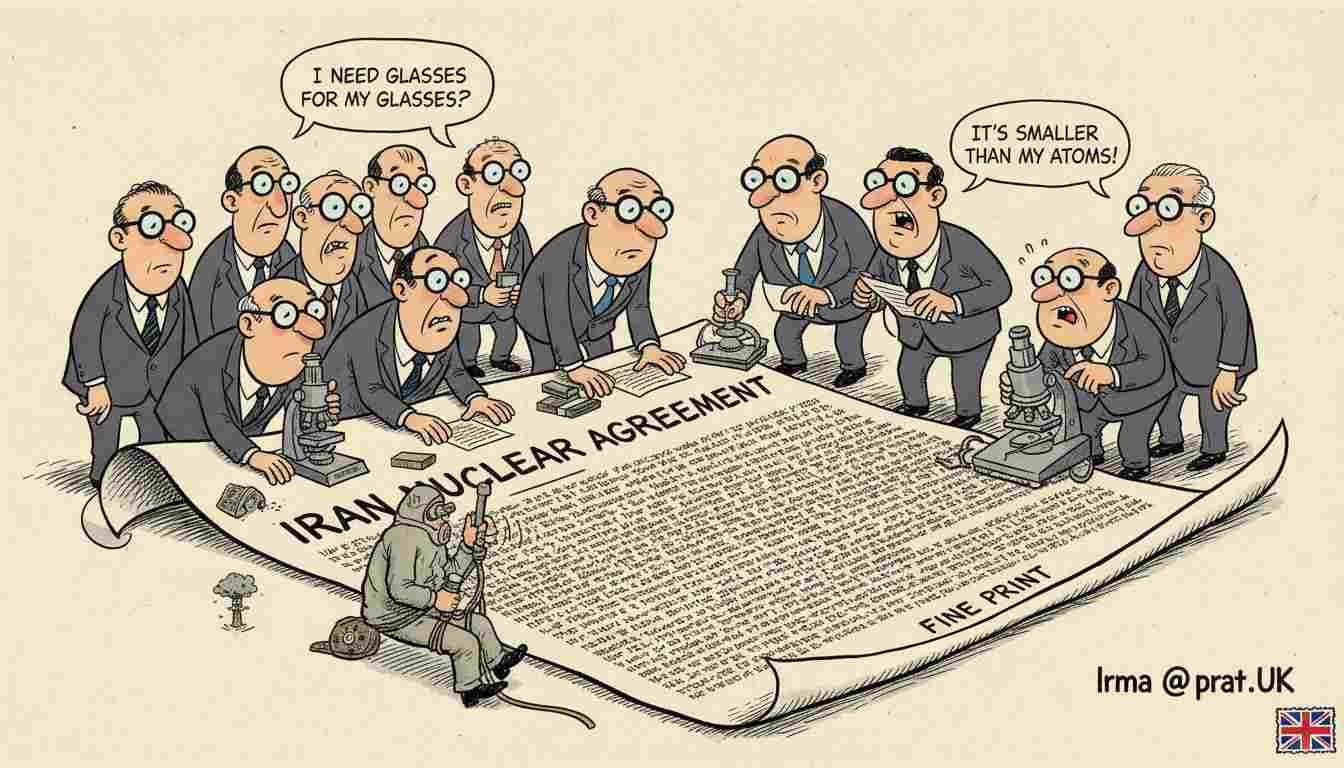
Trump Announces Historic Iran Deal, Promises Everyone Will Read The Fine Print Eventually
Iran Agrees Not To Build Nuclear Weapons, Reserves Right To Build Extremely Suspicious Science Projects
WASHINGTON, D.C. -- President Donald Trump announced what officials are calling a “historic” U.S.-Iran framework deal this week, a diplomatic document so important that several members of Congress immediately demanded to read it before pretending they had already read it.
The reported agreement includes a 60-day negotiation period, a reopening of the Strait of Hormuz, nuclear pledges from Iran, possible access to frozen assets, sanctions relief discussions, and a proposed $300 billion private investment fund tied to a final deal. In other words, it is less a peace treaty than a Middle Eastern group project where everyone has agreed to meet later and define the assignment.
White House officials described the framework as “bold, comprehensive, and subject to interpretation by whichever cable-news panel gets to it first.”
A Group Project With Seven Blast Doors
Iran, for its part, reportedly promised not to acquire or build nuclear weapons, while reserving the right to continue peaceful scientific activities that glow faintly, require underground ventilation, and make inspectors ask, “Why is this laboratory behind seven blast doors and a rug shop?”
“This is strictly civilian research,” said one Iranian official, standing beside a centrifuge labeled Totally Normal Blender For Soup. “We are merely enriching uranium for medical purposes, agriculture, and possibly making the world’s most nervous toaster.”
The International Atomic Energy Agency, the body normally tasked with confirming that a blender is in fact a blender, was not immediately available to comment, possibly because it was busy counting centrifuges that kept being described as kitchen appliances.
Strait Talk: Welcome To Hormuz Plus
The Strait of Hormuz, long considered one of the world’s most important oil passages, is also expected to reopen under the framework. Global markets celebrated after both sides remembered that oil is slightly important to civilization, particularly to automobiles, shipping, heating, plastics, jet fuel, and every politician who has ever said “energy independence” while standing in front of a pickup truck.
A senior diplomat explained that safe passage through Hormuz would be guaranteed “without fees” during the negotiation period, though future arrangements may involve Oman and Gulf states. Economists immediately praised the idea as “the first known attempt to turn a global shipping lane into a gym membership.”
“Basic passage is free,” said a Gulf maritime consultant. “But premium tanker access comes with faster lanes, complimentary dates, and a loyalty program called Hormuz Plus.” He added that the first three tankers ride free, the fourth one gets a punch card, and the tenth one comes with a tote bag.
Congress Squints At A Blank Folder
Congress reacted with its usual blend of urgency, suspicion, and theatrical squinting.
“We demand to see this deal before we decide whether it is treason, genius, appeasement, strength, weakness, or something we can fundraise on,” said one senator, holding a blank folder upside down.
Another lawmaker said the 60-day negotiation period was “encouraging,” noting that the Middle East has always been famous for patience, predictability, and quiet calendar management.
“Sixty days is plenty,” he said. “That’s enough time to solve nuclear proliferation, regional war, sanctions, proxy militias, oil traffic, maritime fees, and whatever angry thing someone posts at 2:13 a.m.”
Three Hundred Billion Reasons To Update Your LinkedIn
The proposed $300 billion private Reconstruction and Development Fund became the immediate star of the deal, because nothing calms geopolitical tension like saying “private-sector investment vehicle” near a smoking crater. Reuters reported the fund would not be government reparations or grants, and would become operational only if a final agreement is reached.
Within minutes, consultants across five continents updated their LinkedIn profiles to “Iran Reconstruction Strategy Thought Leader.”
“I have always been passionate about Persian logistics corridors,” said Brandon Plimswell, a 29-year-old consultant from Arlington who previously specialized in artisanal dog-sock subscriptions. “My firm is uniquely positioned to help Iran transform its infrastructure through slide decks, billable hours, and a hotel breakfast buffet.” He has already trademarked the word “synergy” in two time zones.
Everything Will Be Addressed Later, Including The Word “Later”
In Tehran, officials reportedly welcomed the framework while stressing that final terms remain subject to negotiation, interpretation, translation, regional pressure, domestic politics, and whether anyone involved can survive the phrase “rigorous inspections” without visibly blinking.
An Iranian spokesman said the deal proves diplomacy works.
“America has agreed not to increase military pressure during talks,” he said. “Iran has agreed not to build nuclear weapons. This is a major breakthrough, because both sides have now promised not to do the thing the other side was screaming about.”
Asked whether Iran’s existing nuclear program would be limited under the framework, the spokesman smiled the careful smile of a man walking across a frozen lake in dress shoes.
“These matters,” he said, “will be addressed later.”
That phrase, “addressed later,” quickly became the unofficial slogan of the agreement. Nuclear stockpiles? Addressed later. Sanctions? Addressed later. U.S. withdrawal? Addressed later. Regional ceasefires? Addressed later. The definition of “later”? Also addressed later.
Historians said this places the agreement in the proud diplomatic tradition of documents that begin with “historic breakthrough” and end with six committees, four annexes, and a breakfast meeting in Switzerland where everyone eats fruit nervously. It is the kind of fine print that could fuel a full season of Jon Stewart monologues, and probably will.
President Trump declared the war “over,” prompting historians to begin taking bets on the meaning of “over.” Some argued “over” means hostilities have ended. Others said it means negotiations have begun. A third group, composed mostly of political consultants, defined “over” as “the part where we start selling hats.”
From An Ohio Diner To A Houston Tanker
At a diner in Ohio, retired machinist Earl Puckett said he supported the deal because he liked the idea of fewer wars, cheaper oil, and politicians having to explain themselves in complete sentences.
“I don’t know what’s in the fine print,” Puckett said, “but I assume it’s like every phone contract I ever signed. By paragraph six, I apparently owe somebody in Geneva my garage.”
In Houston, tanker dispatcher Marlene Alvarez said reopening Hormuz was good news for shipping.
“You don’t realize how important a narrow waterway is until half the planet starts staring at it like it’s the last bathroom at a football stadium,” she said.
A Georgetown professor of international relations, Dr. Milton Scaffolding, described the framework as “diplomatic scaffolding around a burning building.” You can follow how that building keeps not collapsing in the ongoing coverage over at Latest Story Magazine.
“That does not mean the building is saved,” he said. “But at least someone has stopped throwing gasoline long enough to discuss whether gasoline should be item seven or item eight.”
Cautiously Optimistic For Twelve Minutes
Meanwhile, oil traders responded with cautious optimism, which in their industry means buying, selling, panicking, and naming a new volatility index after a throat noise.
A Wall Street analyst said the agreement was “market positive,” provided that all parties comply, no one changes their mind, no proxy group fires anything, no parliament objects, no inspection dispute erupts, and everyone involved continues behaving like adults in a room full of microphones.
“So,” he added, “we are cautiously optimistic for twelve minutes.”
The deal’s critics warned that Iran’s promise not to build nuclear weapons may be too vague without immediate restrictions on enrichment and stockpiles. Supporters countered that the framework creates a path toward a final agreement, which is diplomat language for “we found the door, now we must determine whether it opens into a conference room or a broom closet.”
At the United Nations, delegates praised the agreement in eleven languages, then privately asked aides whether they were supposed to like it.
“This is a moment of hope,” said one European official. “And by hope, I mean the condition that exists when nobody has read the annex.”
In Washington, the State Department insisted the fine print would be available soon, just as soon as lawyers, diplomats, translators, lobbyists, inspectors, regional allies, financial institutions, shipping authorities, defense officials, and three people named Kevin finish making sure the same sentence does not mean six different things in four capitals.
Until then, Americans have been advised to remain calm, trust the process, and remember that international diplomacy is mostly two enemies signing a document that says, “We agree to argue in a nicer hotel.”
Trump, Iran, nuclear, sanctions, Hormuz, and diplomacy all walked into the same paragraph this week, and only the hat salesman left with a profit.
Disclaimer: This is satire. No uranium was enriched in the writing of this article, although a few sentences came dangerously close to glowing and one paragraph still hums faintly at night. It is built on publicly reported claims and political commentary, then exaggerated until reality blinked first. This piece is a human collaboration between two sentient beings: the world’s oldest tenured professor and a philosophy major turned dairy farmer.
For the British cousin of this nonsense, cross the pond and visit our friends at The London Prat.
Auf Wiedersehen, amigo! https://bohiney.com/historic-iran-deal-read-the-fine-print/

Comments
Post a Comment