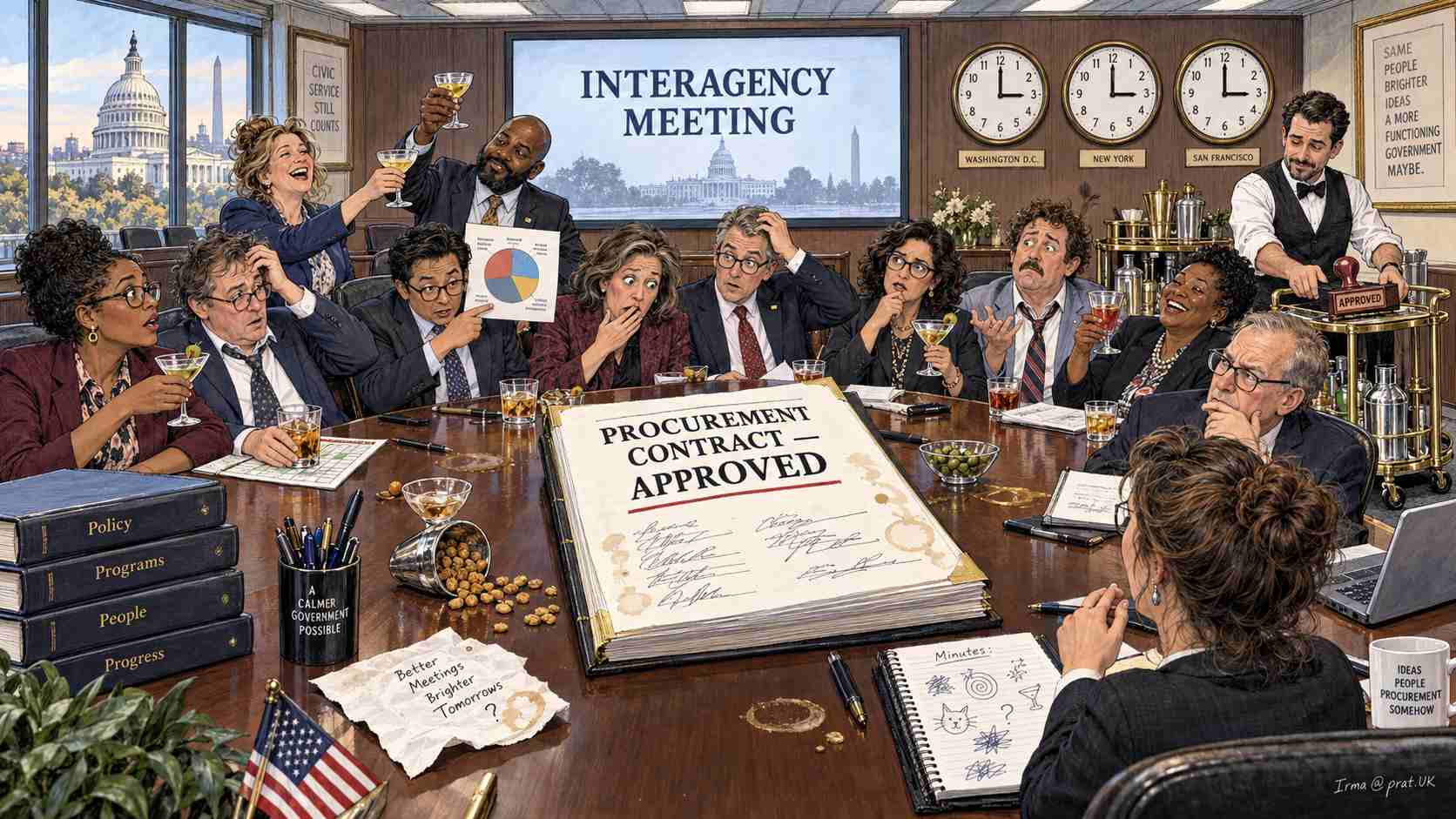
Alcohol at the Office Is One Way to Improve Government Meetings
Federal meetings normally feel three hours long. Introduce cocktails and suddenly they actually are three hours long, but nobody remembers approving the procurement contract.
The Department of Labor has apparently discovered the one workplace innovation Silicon Valley never thought of: if a meeting is unbearable sober, perhaps the meeting simply needs a beverage program.
A newly released Labor Department inspector general report concluded, using a preponderance-of-the-evidence standard, that former Labor Secretary Lori Chavez-DeRemer and senior aides Jihun Han and Rebecca Wright regularly possessed and consumed alcohol on federal property without the required written authorization. Witnesses told investigators that alcohol was consumed during duty hours in Chavez-DeRemer's study and that employees who declined were sometimes pressured to join or ridiculed for abstaining.
At last, government has attacked the central problem facing American productivity: some meetings end while participants are still capable of remembering them.
The private sector has Zoom. The federal government apparently experimented with Cabernet.
Nobody knows whether this improved policy formation, but anyone who has attended a bureaucratic meeting understands the theory.
What a Sober Federal Meeting Sounds Like
A normal federal meeting begins:
"Before we begin, does everybody have the revised appendix to the preliminary agenda concerning formation of the working group?"
Thirty minutes later:
"Linda, you're still muted."
Add alcohol and the same meeting begins:
"Before we begin, does everybody have the revised appendix?"
"Forget the appendix, Steve. Tell us what you really think about procurement."
Now we're governing.
The Federal Government Already Had a Form for Drinking on Federal Property
The most magnificent detail is not that alcohol was allegedly being consumed.
It is that Washington already had paperwork specifically designed for drinking alcohol in a government building.
Labor Department policy permitted alcohol on federal premises under certain circumstances with advance written authorization, documented through something called Form DL1-6054, Alcoholic Beverage Exemption Request/Authorization. Investigators reported finding no such authorization covering the drinking they examined.
Of course there is a form.
This is America.
You cannot merely open a Chardonnay.
First, Chardonnay must demonstrate standing.
Then Chardonnay must be entered into the administrative record.
Then a career civil servant has to determine whether Pinot Grigio constitutes an appropriate official use or an unauthorized fermented personnel initiative.
The Checkbox Washington Forgot to Print
Somewhere there is probably a checkbox:
PURPOSE OF ALCOHOL
- ☐ Diplomatic reception
- ☐ Official ceremony
- ☐ Employee recognition
- ☐ We have been discussing the same spreadsheet since February
That last one would probably receive bipartisan support.
Government Discovers the Three-Martini Performance Review
Witnesses described a workplace that investigators said became "toxic, intimidating and humiliating," including meetings where employees were berated over perceived deficiencies. Thirty-eight witnesses gave broadly consistent descriptions of the office environment, according to the report. The findings arrive after months of escalating disclosures that cost the secretary both of her top aides.
This does introduce a fascinating management question.
If the boss is drinking and the employee is drinking, is it still a performance review or have you accidentally opened a neighborhood bar with unusually aggressive annual evaluations?
"Your communication skills need improvement."
"Can you be more specific?"
"You're fired."
"Can I get another bourbon?"
"Now you're showing initiative."
Corporate Euphemism Reaches Its Final Form
Corporate America has spent decades inventing terminology to make miserable experiences sound beneficial.
You are not being criticized. You are receiving feedback.
You are not getting fired. You are experiencing a career transition.
You are not sitting in an intimidating meeting while senior officials drink. You are participating in immersive leadership development with refreshments.
The report even says witnesses told investigators that employees who did not drink could be pressured or mocked for abstaining.
That may be the first federal workplace initiative where the designated driver needed whistleblower protection.
The Meeting Minutes Become Much More Interesting
Traditional meeting minutes are painfully dull.
"Deputy Assistant Secretary Johnson discussed fourth-quarter staffing requirements."
Under the experimental system:
"Deputy Assistant Secretary Johnson discussed fourth-quarter staffing requirements, declared the organizational chart 'a pyramid scheme with dental insurance,' and challenged the Office of Management and Budget to come outside."
Now citizens would actually read government documents.
C-SPAN ratings would explode.
Committee hearings would stop beginning with "I yield five minutes to the distinguished gentleman from Ohio" and begin with:
"Before I answer that, Senator, I want you to know something about Gary from Compliance."
Government transparency solved.
Washington Has Been Trying to Fix Meetings the Wrong Way
For decades, consultants have proposed shorter agendas, standing meetings, electronic collaboration, clear deliverables and action items.
Amateurs.
Nothing shortens a policy discussion like somebody announcing:
"Before we continue, who finished the Scotch?"
Suddenly everybody discovers consensus.
The environmental impact statement? Approved.
New office furniture? Approved.
Budget reconciliation? Nobody understands it sober anyway, so we may actually be making progress.
Federal Procurement Was Not Built for This
The danger arrives when procurement enters the conversation.
Federal contracting law is complicated enough when everyone can pronounce "competitive bidding."
Three drinks into the meeting:
"We awarded the software contract to a company called Dave."
"What does Dave manufacture?"
"He seemed trustworthy."
"Does Dave have a DUNS number?"
"He has a truck."
The Labor Department Makes the Joke Almost Too Perfect
The Department of Labor exists, among other things, to protect workers and enforce workplace standards. Its own inspector general concluded that Chavez-DeRemer violated department standards concerning workplace harassment and unauthorized alcohol consumption, as well as rules involving travel, government resources and gifts.
There is something exquisitely governmental about an agency responsible for workplace conditions producing a report about its own workplace conditions.
Imagine the Department of Transportation announcing all elevators are broken.
Imagine Agriculture running out of food.
Imagine Treasury asking whether anybody can spot them twenty bucks until payday.
Labor developing labor problems is almost too symmetrical.
It is bureaucratic performance art.
A Modest Reform for Federal Meetings
The answer is not banning meetings.
America has tried everything except the obvious solution: make federal officials justify each meeting using the same standards applied to alcohol.
Before scheduling any gathering longer than 45 minutes, management should complete Form MEET-6054, certifying that:
- The meeting serves an official purpose.
- No email could accomplish the same thing.
- There will be fewer than nine PowerPoint slides containing arrows.
- Nobody will say "circle back."
- Anyone using the phrase "synergistic stakeholder engagement" must surrender their chair immediately.
And if alcohol is present, everyone receives a printed copy of the procurement regulations before the second round.
Because government meetings may occasionally need a drink.
But the taxpayers should never wake up the next morning wondering why they own six thousand ergonomic ottomans and a cloud-computing company called Dave.
The Strip Club Expense Raises Fascinating Questions About Federal Accounting
Government accountants have categories for transportation, lodging, meals and incidental expenses. We may now need: "Incidental Glitter."
Federal travel accounting has spent decades classifying nearly every imaginable human need: airfare, hotels, mileage, meals, parking, tolls and those mysterious "incidentals" nobody completely understands but everyone confidently initials.
Then the Labor Department inspector general described an April 2025 Oregon stop that may require accountants to expand the chart of accounts.
According to the report, Chavez-DeRemer requested an off-the-record stop at an establishment that turned out to feature partially nude dancers. Investigators said she gave money from her purse to a member of her protective detail and directed him to give it to a performer. When he resisted, the supervising agent told him to comply; Chavez-DeRemer then allegedly supplied more money and asked the agent to drop the bills individually onto the performer. The report says the agent complied against his wishes.
Important accounting clarification: the report does not say those particular bills were reimbursed by taxpayers. They were described as coming from Chavez-DeRemer's purse.
That saves taxpayers several dollars while creating approximately four hundred additional federal questions.
Welcome to Meals and Incidental Glitter
Government employees traveling officially receive what federal regulations call M&IE: meals and incidental expenses.
Historically, "incidentals" meant small necessary travel costs.
It probably did not mean:
INCIDENTAL EXPENSE, OTHER: $20
PURPOSE: PARTICIPATORY ENTERTAINMENT COMPLIANCE
You can imagine the expense report.
- Merchant: Unknown
- Category: Other
- Business purpose: Labor-market research
- Receipt attached: Absolutely not
- Supervisor approval: Please stop asking
An accountant would stare at this for seven minutes, remove his glasses and quietly apply for a job at Costco.
Federal accounting can handle a Black Hawk helicopter.
It can depreciate a naval vessel.
It can calculate mileage reimbursement to three decimal places.
But somebody eventually has to decide what happens when an on-duty security employee is instructed to place privately supplied currency onto an entertainer.
The spreadsheet simply was not emotionally prepared.
The Government Has Entered the Service Economy
One could argue that the episode involved direct participation in America's service sector.
Economists are forever asking policymakers to engage with workers.
Technically, this was engagement.
Too much engagement, perhaps.
A listening tour normally means meeting welders, nurses, truck drivers, construction workers and small-business owners.
Nobody tells you there is an advanced seminar.
"Madam Secretary, what did you learn from America's workers?"
"The importance of tipping."
"Anything else?"
"Boundaries."
"And the Oregon labor market?"
"Extremely flexible."
This is why economists should specify what they mean.
The Security Detail Got an Unexpected Assignment
Protective agents presumably train for threats, emergency evacuation, crowd control, motorcades and keeping Cabinet officials alive.
Then one day the assignment apparently becomes:
Protectee requests cash distribution to dancer. Please advise.
There is no possible way this was covered properly in orientation.
- "Module Seven: Counter-surveillance."
- "Module Eight: Motorcade extraction."
- "Module Nine: What To Do When Your Principal Hands You Bills in an Establishment Featuring Partially Nude Performers."
The agent reportedly resisted and sought guidance. The supervising official instructed him to comply, according to the inspector general. Investigators ultimately said the conduct violated Labor Department harassment policy.
That is the moment this stops merely being a naughty-travel anecdote and becomes a workplace story.
The performer was doing her job.
The security employee was also doing his job.
Only one of those occupations apparently came with a surprise assignment.
Federal Travel Forms Were Never Built for Humanity
The inspector general separately found problems involving personal and official travel, including trips where lodging exceeded applicable federal rates and where investigators found required approvals or justification missing.
This is where federal travel rules achieve transcendence.
Government may spend billions on projects nobody can explain, but try charging $14 too much for breakfast and suddenly the republic awakens.
A travel voucher is the great equalizer.
Presidents may command armies.
Cabinet secretaries may shape national policy.
But somewhere there is a GS-11 named Barbara saying:
"I still need the hotel folio."
Civilization survives because of Barbara.
Introducing Form GLTR-69
The obvious reform is a new federal accounting classification:
INCIDENTAL GLITTER
Eligible expenses could include:
- Unexplained sequins attached to government clothing.
- Emergency laundering after "stakeholder engagement."
- Protective-detail therapy.
- Accountant overtime spent determining whether dollar bills qualify as entertainment, gratuity or "other."
Not reimbursable:
- Anything requiring the phrase "off the record" before entering the venue.
- Anything where the security agent asks, "Do I really have to?"
- Anything that causes the Inspector General to devote more pages to the evening than your agency devoted to apprenticeship policy that month.
This would give accountants the certainty they crave.
The Phrase Off the Record Deserves Its Own Appropriation Code
The report says the Oregon stop was requested as an "off-the-record" stop.
Washington uses "off the record" constantly.
Usually it means a reporter cannot quote you.
In federal travel, it apparently should mean:
ACCOUNTING HAS ENTERED THE CHAT.
Government should establish a universal principle: if an official says "off the record" during a taxpayer-supported trip, three accountants automatically appear.
Not metaphorically.
Physically.
They should descend from a government sedan carrying calculators.
"Good evening. We heard someone say 'off the record.' Please produce itinerary, receipts and justification."
You would eliminate half of Washington's scandals by midnight.
America Has Finally Found Truly Trickle-Down Economics
Economists have argued about trickle-down economics for forty years.
Apparently somebody finally demonstrated it literally.
Money starts near the top of government.
Money moves downward.
One bill at a time.
Economists everywhere slap their foreheads.
"That's what Reagan meant?"
No.
But satire rarely receives a metaphor this cooperative.
The Accountant Always Wins
The scandalous details may attract attention, but the quieter lesson is much funnier.
Public officials live in a world where every action can eventually encounter an auditor.
You can call something informal.
You can call it personal.
You can call it off the record.
You can call it a quick stop.
Eventually somebody in a windowless office opens Excel.
And Excel has no sense of romance.
Excel does not care about Vegas, Oregon, entourages, rodeos, cocktails or nightlife.
Excel wants three things:
Date. Amount. Business purpose.
Everything else is glitter.
Fourteen Humorous Observations About Drinking, Glitter and Federal Paperwork
- Every empire eventually invents a form for the thing it swore it would never do, and then loses the form.
- The federal government can classify a submarine but cannot classify a Tuesday.
- A meeting improves the instant somebody stops reading the agenda out loud.
- If your workplace requires a bourbon to survive, the bourbon is not the innovation. It is the symptom with a nice label.
- Any office where abstaining gets you mocked has quietly become a fraternity with a payroll system.
- Washington has two speeds: nothing happens for nine months, then everything happens in one PDF.
- The most dangerous phrase in government is not "national emergency." It is "quick stop."
- Nobody ever put "off the record" on a receipt and had it end well.
- A security detail trains for snipers and gets ambushed by an errand.
- The Department of Labor writing a report about its own working conditions is the closest thing government has to a mirror.
- Excel is the only entity in Washington that has never once been charmed by anybody.
- The GS-11 asking for your hotel folio has outlasted six administrations and will outlast you.
- Trickle-down economics finally worked, and everyone involved wishes it hadn't.
- The republic can survive alcohol in the office. It cannot survive procurement decisions made by people who found Dave charming.
Disclaimer
This is satire based on publicly reported findings of the U.S. Department of Labor Office of Inspector General. The report applied a preponderance-of-the-evidence standard, and some individuals discussed in it declined investigators' interview requests. It also expressly stated that investigators did not find sufficient direct evidence to establish that Chavez-DeRemer and the protective-detail official had a romantic or sexual relationship.
This story is entirely a human collaboration between two sentient beings: the world's oldest tenured professor and a philosophy major turned dairy farmer.
Read the U.S. Department of Labor Inspector General report https://bohiney.com/alcohol-at-the-office/

Comments
Post a Comment