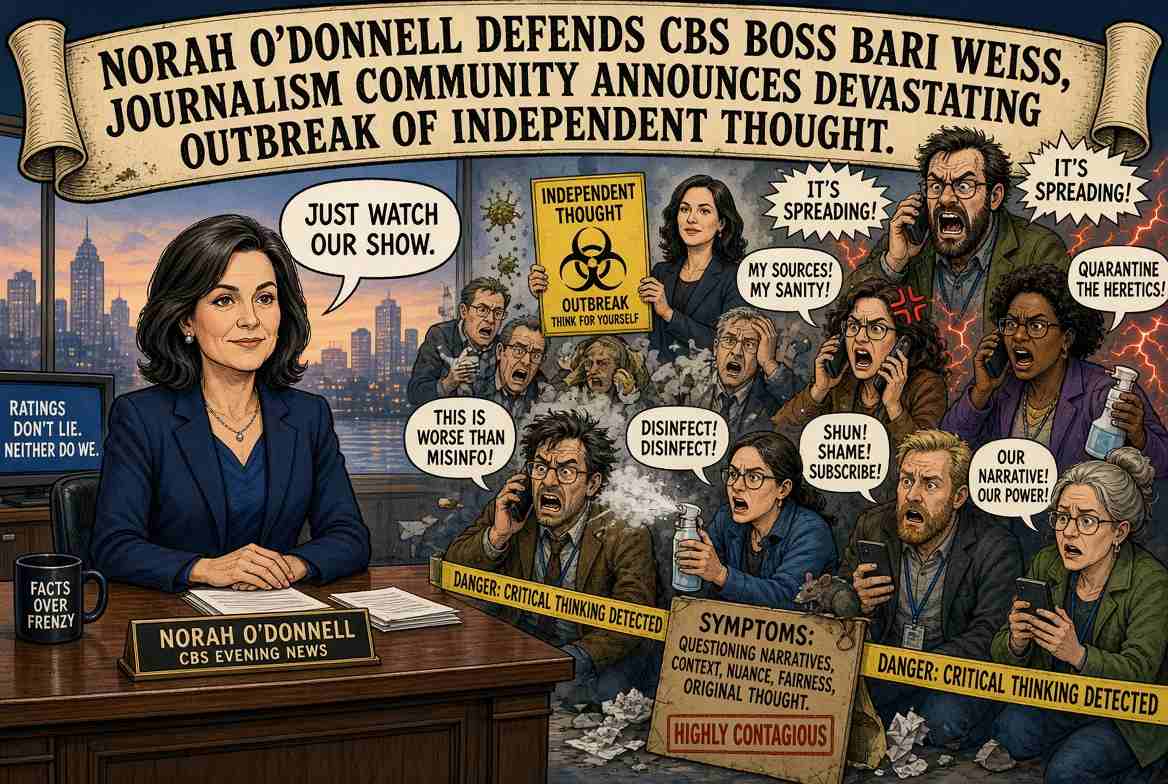
Norah O'Donnell Defends CBS Boss Bari Weiss, Journalism Community Announces Devastating Outbreak of Independent Thought
CBS anchor tells furious liberals "just watch our show," accidentally introducing evidence-based reasoning to social media as the Daily Beast mobilizes an emergency television seriousness task force
NEW YORK — American journalism was placed under emergency intellectual quarantine this week after CBS News veteran Norah O'Donnell suggested that people angry about CBS might consider watching CBS before determining precisely how angry they should be about CBS. Doctors describe her condition as "stable but reasonable," which is its own kind of scandal these days.
The terrifying proposal surfaced as O'Donnell prepared to return to CBS Mornings alongside Gayle King and Nate Burleson beginning September 8. CBS described the move as O'Donnell "coming home" after previously co-hosting the morning program before moving to the CBS Evening News, a sentence that reads suspiciously like a hostage statement filmed in a break room.
Then came the scandal.
Faced with angry social-media commenters criticizing CBS under editor-in-chief Bari Weiss, O'Donnell reportedly encouraged them to give the program a chance and dismissed the idea of abandoning CBS altogether as "silly." The Daily Beast responded with the headline "CBS Star Humiliates Herself With Desperate MAGA-Curious Boss Defense," demonstrating once again that television journalism remains the only profession in which asking somebody to examine the product can constitute a public breakdown, right up there with a dentist recommending flossing.
America was shaken. Several people reportedly had to sit down.
"Watch the show?" asked one citizen staring into his phone as if it had just insulted his mother. "What am I, a researcher? I have a finite number of thumbs and I've allocated all of them to scrolling."
Within minutes, social media experts confirmed that O'Donnell had accidentally introduced evidence-based reasoning into an ecosystem specifically engineered to prevent it, the digital equivalent of bringing a salad to a hot-dog-eating contest.
Scientists confirm watching something before reviewing it remains technically possible
For generations, Western civilization operated under a cumbersome intellectual system in which people were expected to encounter a thing before developing detailed opinions about it. Historians call this era "before Wi-Fi."
You read the book. Then reviewed the book.
You watched the movie. Then condemned the movie.
You tasted the restaurant's food. Then informed Yelp that the risotto had personally betrayed the Italian people, possibly on behalf of a rival trattoria.
This primitive arrangement collapsed with social media, where citizens can now evaluate articles from headlines, movies from trailers, legislation from memes and CBS News from the political biography of whichever executive currently occupies an office upstairs. It is, in its own way, a miracle of efficiency — like judging a marathon from the starting gun.
O'Donnell's suggestion therefore represents a dangerous regression toward the Enlightenment. The principle is alarmingly straightforward:
Premise one: You believe CBS has changed.
Premise two: CBS broadcasts programs demonstrating whether CBS has changed.
Conclusion: Watch one.
Philosophers described the logic as "disturbingly linear." Social media immediately rejected it for lacking sufficient exclamation points and at least one crying-laughing emoji.
Journalism community announces first confirmed case of independent thought since Tuesday
The controversy intensified because O'Donnell did something modern political culture increasingly regards as suspicious: she declined to perform the exact denunciation demanded of her.
She did not fling her CBS identification badge into the Hudson.
She did not rappel down Black Rock carrying a banner reading RESIST BARI, though frankly the visual would have tested very well.
She did not interrupt CBS Mornings to announce that democracy would survive only if viewers immediately switched to a competing multinational broadcasting corporation with its own set of billionaire owners and editorial headaches.
Instead, she basically said: watch us.
This was interpreted by critics as defending Weiss, whose tenure at CBS has produced significant internal controversy, including reported friction among CBS anchors themselves over how the network's flagship morning show should be reshaped. The Daily Beast has repeatedly characterized Weiss as "MAGA-curious" or "MAGA-coded," while critics inside and outside CBS have challenged her leadership and interventions in news coverage.
Which is perfectly legitimate territory for scrutiny.
But there remains a small technical distinction between scrutinizing Bari Weiss and requiring every CBS employee to appear hourly in a public square and denounce her while ringing a bell, ideally one made of recycled cable-news set pieces.
Modern journalism sometimes struggles with this distinction because outrage has become less a reaction than a subscription model, complete with tiered plans and a free trial.
CBS viewer attempts radical experiment: watching CBS
At approximately 7:14 a.m., an unidentified American reportedly attempted O'Donnell's experiment.
He turned on CBS.
Nothing immediately happened.
He watched another four minutes.
Still nothing.
Nobody goose-stepped through the weather forecast. Gayle King did not sacrifice the First Amendment over a breakfast sandwich. A chyron did not announce, BREAKING: REPUBLIC ABOLISHED BEFORE TRAFFIC.
The viewer became confused.
"I was promised an ideological apocalypse," he explained to his toaster, which did not respond, having wisely stayed out of media criticism entirely. "Instead somebody is interviewing an actor."
Researchers believe this represents what psychologists once called disconfirming evidence, a phenomenon largely eradicated from political discourse around 2016 and last spotted in the wild shortly thereafter.
Disconfirming evidence occurs when reality commits the discourtesy of failing to resemble your social-media feed. Treatment traditionally involved changing your mind. Modern treatment involves changing channels, then tweeting about the channel you didn't change to.
Boycotting CBS becomes nation's most popular program on CBS
Calls to boycott television networks have meanwhile become one of America's most successful forms of imaginary activism.
The economic model is elegant.
A citizen who has not watched CBS since Murder, She Wrote announces: "I AM DONE WITH CBS."
CBS executives are then expected to run screaming through Manhattan because somebody who contributed approximately zero dollars to quarterly revenue has reduced that contribution to zero dollars, a mathematical feat rivaling the invention of the number zero itself.
It is activism with no parking, no marching and practically no muscular involvement.
One can boycott CBS while watching Netflix. Boycott Netflix while watching YouTube. Boycott YouTube while scrolling X. Boycott X by posting seventeen times explaining why you have left X forever, complete with a farewell thread longer than most CBS segments.
The American boycott has finally achieved quantum mechanics: you can simultaneously leave a platform and remain on it arguing about having left.
O'Donnell's use of the word "silly" therefore struck a sensitive national nerve. Nobody enjoys discovering that his heroic resistance campaign consists primarily of not watching CBS Mornings while eating Cheerios he definitely did not boycott.
Daily Beast reminds nation television must be taken extremely seriously
The phrase "humiliates herself" deserves appreciation.
Because O'Donnell did not fall off the anchor desk. She did not accidentally conduct the weather in Spanish. She did not interview a coat rack, though ratings suggest the coat rack might poll competitively in certain demographics.
She defended returning to work and encouraged unhappy viewers to watch the program.
If this is humiliation, American offices contain 74 million daily catastrophes. Every LinkedIn post reading "Thrilled to begin another exciting chapter with this incredible team" must now be regarded as a public degradation ritual performed in business casual.
Imagine applying the same standard elsewhere:
"Local Dentist Humiliates Himself by Defending Dental Practice."
"Assistant Manager Disgraces Family by Saying Olive Garden Has Excellent Team Culture."
"Costco Employee Debases Himself by Suggesting Customers Enter Costco Before Reviewing Costco."
Yet television journalism receives special treatment because the industry increasingly covers itself with the solemnity once reserved for constitutional crises. A producer changes chairs and six media reporters explain what it means for democracy. An anchor moves to mornings and analysts discuss "the future of trust." Somebody changes the studio lighting and a Substack appears titled The Darkness at CBS.
Television executives must occasionally wonder whether they operate broadcasting companies or Balkan republics with better catering.
Bari Weiss becomes political Rorschach test with office keycard
None of this means Weiss should escape criticism.
Her appointment and subsequent stewardship of CBS News have generated genuine controversy, including reported disputes over editorial judgment and personnel decisions at the network. Critics have raised substantive questions about her experience, management style and political influence.
Those questions deserve reporting.
But there is an amusing leap from "we should scrutinize Weiss's editorial decisions" to "Norah O'Donnell must resign because she did not dislike her boss loudly enough on Instagram."
That is no longer media criticism. That is middle-school lunch-table governance with better typography and a slightly larger microphone budget.
The role reversal is delicious. Journalists traditionally lecture audiences to avoid misinformation, consider multiple perspectives and judge claims according to evidence. Then an audience member says, "I hate the new CBS." O'Donnell responds, "Watch it." And suddenly evidence is corporate propaganda.
Social media discovers "give it a chance" is gateway drug to centrism
Experts fear O'Donnell's rhetoric could spread.
Today you watch CBS before judging CBS. Tomorrow you read an article before sharing it. By Wednesday you might read an opposing argument all the way to the end. Soon you are saying reckless things at dinner such as, "I see what you mean."
Civilization cannot survive this.
Under the slippery-slope principle governing all internet disagreements, one act of curiosity inevitably leads to nuance, nuance leads to uncertainty, uncertainty leads to conversation, and conversation eventually results in somebody admitting a political opponent made one reasonable point back in 2014. At that stage, democracy collapses, or at minimum somebody unfollows a cousin.
The safer alternative is immediate certainty. Know everything instantly. Preferably before breakfast, and definitely before the segment has finished airing.
Morning news introduces revolutionary new format: news
CBS says O'Donnell, King and Burleson will form its morning team as the network emphasizes live conversations and coverage heading toward the 2026 midterms.
This presents CBS with an extraordinary opportunity. Instead of constructing programming exclusively for conservatives or liberals, executives could attempt the antiquated broadcasting strategy known as making something people want to watch.
It sounds naive. Possibly unconstitutional. But television once operated this way. Networks competed for viewers rather than ideological Yelp stars. Anchors reported developments without audiences demanding sworn affidavits proving whom they privately disliked. People sometimes watched journalists with whom they disagreed. Occasionally they even survived, and lived to complain about it on a podcast.
Helpful guide for surviving television you disagree with
For viewers emotionally preparing for O'Donnell's return, public-safety officials recommend the following procedure:
Turn on CBS. Observe what happens. If you like it, continue. If you dislike it, change channels.
This procedure requires approximately one thumb. Citizens with older televisions may need an index finger, and a small prayer to whichever deity governs remote-control batteries.
No protest permit is required. No ideological purity certificate must be completed. You are also permitted to disagree with Bari Weiss without disliking Norah O'Donnell, dislike CBS without boycotting CBS, boycott CBS without issuing a press release, or watch CBS while believing everybody involved is catastrophically wrong.
This condition is known as being an adult. Scientists believe millions still possess the capability, though funding is needed to confirm the exact number.
America asked to consider terrifying possibility that television is television
By week's end, the crisis showed no sign of subsiding. Partisans continued determining CBS's ideological status. Media writers continued determining whether O'Donnell had embarrassed herself. Commenters continued announcing they would never watch a television show whose alleged ideological corruption they intended to monitor continuously, presumably by watching it.
And somewhere inside CBS, Norah O'Donnell prepared to sit behind a desk and say good morning.
That may ultimately be the funniest part. A veteran journalist tells people irritated by a news program to watch the news program. Her critics respond that asking them to gather direct evidence proves she has lost credibility. We have finally constructed a media culture in which curiosity itself can be interpreted as bias.
The old journalism slogan was: "If your mother says she loves you, check it out."
The updated version appears to be: "If your mother says she loves you, first determine whether your mother is MAGA-coded, woke-adjacent, centrist-curious, problematic, insufficiently problematic or currently employed by Paramount."
Then block her.
15 observations to sharpen the knives
- "Watch before judging" is now a dangerously experimental form of journalism. We previously tested it on books, movies and criminal trials, with mixed results.
- Social media has eliminated the inconvenient middleman formerly known as "seeing what happened."
- Boycotting a television show you already stopped watching is the American consumer's most affordable political protest.
- O'Donnell calling the boycott "silly" caused outrage because nobody likes having the operating principle of the internet identified publicly.
- The modern political spectrum runs from "I haven't watched CBS in years" to "I demand CBS immediately change the program I haven't watched in years."
- Apparently defending your employer is humiliating. LinkedIn has therefore become history's largest public collection of humiliations.
- Bari Weiss doesn't even have to appear on television anymore. She can simply exist somewhere in the building and half the internet hears ominous violin music.
- Morning television used to require coffee, weather and recipes. It now apparently requires ideological customs inspection.
- People once complained news anchors were too opinionated. Now an anchor saying "give it a chance" is insufficiently opinionated in the correct direction.
- The Daily Beast calling O'Donnell's response humiliating inadvertently makes her argument for her: perhaps viewers could inspect the evidence themselves.
- Television boycotts are magnificent because nobody can verify whether you participated. "I heroically didn't watch CBS at 8:12 this morning." Medal forthcoming.
- We have entered the intellectual phase where curiosity itself needs a political affiliation.
- Cable-era America trained everyone to believe the remote control was a voting machine. Unfortunately, nobody has conceded an election since.
- O'Donnell suggested watching the show. Within minutes, America rediscovered why evidence is unpopular: it requires homework.
- The greatest threat to partisan certainty remains encountering information accidentally.
Disclaimer: This satire exaggerates the very real media argument surrounding Norah O'Donnell's return to CBS Mornings, criticism of CBS leadership under Bari Weiss, and O'Donnell's public response to viewers threatening to abandon the network. No television anchors were ideologically purified during production. Any resemblance to rational public discourse is purely accidental. https://bohiney.com/norah-odonnell-defends-cbs-boss-bari-weiss/

Comments
Post a Comment