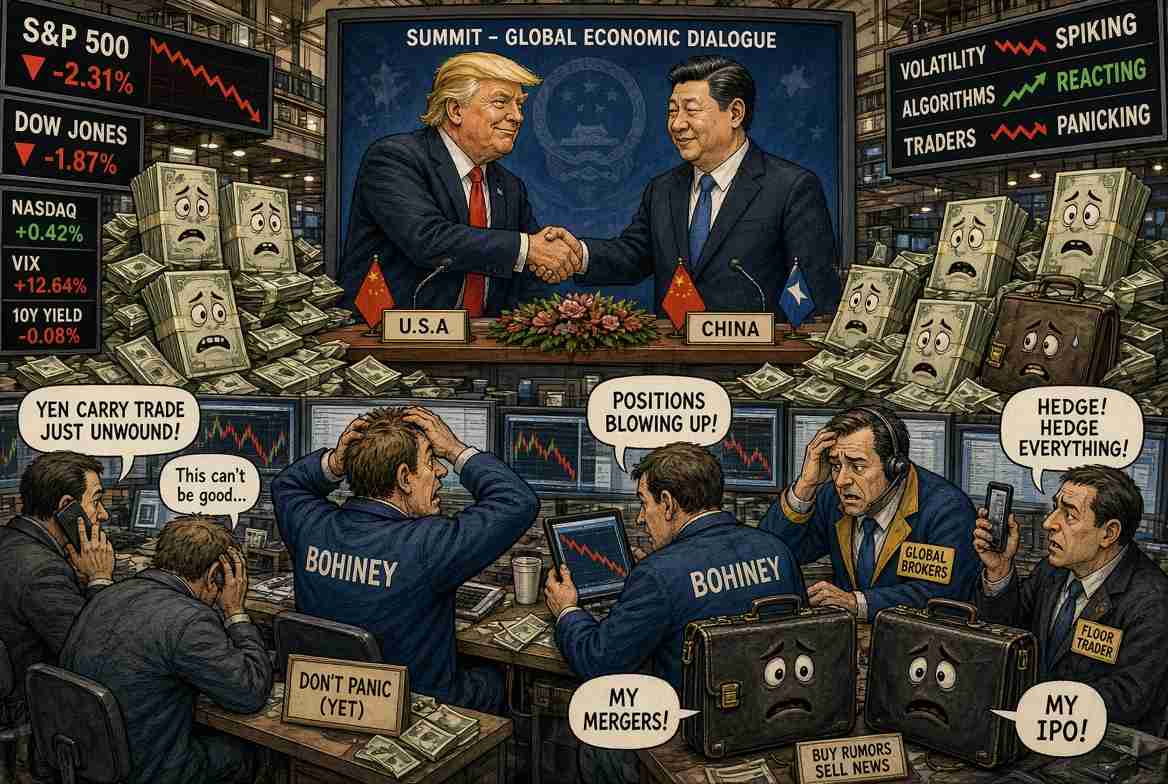
Wall Street Watches Trump-Xi Summit, Economists Replace Forecast Models With 'Well, Let's See What Happens'
Two presidents meet, several trillion dollars politely pretend not to be nervous
NEW YORK — Financial markets are preparing for this week's meeting between U.S. President Donald Trump and Chinese President Xi Jinping, which means highly trained economists armed with advanced quantitative models have reached the professional conclusion commonly expressed as: "Could go either way."
Trump and Xi are expected to discuss trade, artificial intelligence, strategic minerals and broader geopolitical tensions during Xi's Washington visit. Markets are watching for signs involving tariffs and trade stability, tracked in real time by outlets like The Wall Street Journal, while China's yuan has strengthened ahead of the talks.
Uncertainty, Rebranded
This is what Wall Street calls "uncertainty." Normal people call it "Wednesday." Economists spend decades developing models containing interest rates, currency movements, trade flows and productivity estimates. Then two presidents enter a room. The spreadsheet whispers, "I have no idea."
Markets particularly dislike surprises. Unfortunately, international diplomacy is surprise wearing a necktie. Trade between the United States and China is sufficiently vast that a sentence spoken at a podium can alter commodity prices, currencies and corporate expectations before the interpreter reaches the period.
Copper Futures Require Medical Attention
A reporter asks: "Did the talks go well?" The president says, "Very productive." Stocks rise. Another official says, "Substantial differences remain." Stocks fall. Someone tweets a flag emoji. Copper futures require medical attention.
The talks come amid disputes involving tariffs, technology and AI, while Washington and Beijing are also discussing possible areas of cooperation, an agenda tracked closely by the Council on Foreign Relations. Negotiators have separately explored issues including American LNG exports and Chinese tariffs on U.S. energy.
A Divorce Where Both Parties Still Own Costco Together
This is modern geopolitics. Countries can simultaneously compete over artificial intelligence, criticize one another's trade policies and negotiate natural-gas purchases. International relations is basically a divorce where both parties still own Costco together.
Wall Street must assign prices to all of it. Traders therefore parse diplomatic vocabulary with the intensity medieval scholars once reserved for scripture. "Constructive dialogue" means one thing. "Frank exchange" means another. "Candid discussion" usually means somebody raised his voice. "Historic breakthrough" means sell before Thursday.
This Happened, Although It May Not Continue Happening
Currencies are especially sensitive. China's yuan recently reached its strongest level in more than three years as the People's Bank of China eased efforts to restrain appreciation ahead of the summit. Analysts cautioned that the move does not necessarily imply a lasting currency trend.
There it is. The sentence economists were put on Earth to produce: "This happened, although it may not continue happening." You cannot argue with it. You also cannot trade on it unless your investment horizon is approximately eight minutes.
Plan D Is Apparently Vietnam
Businesses face a more practical problem. Companies planning factories, supply chains and investments need some idea what tariffs and trade rules will look like years from now. Politics often offers guidance through next Tuesday. So executives develop contingency plans. Plan A assumes improved relations. Plan B assumes tariffs. Plan C assumes more tariffs. Plan D is apparently "Vietnam."
The Trump-Xi meeting may produce agreements, narrower understandings or simply continued negotiations. Its precise economic impact will depend on what is actually announced and implemented, not merely summit language.
Maybe Don't Touch Anything
That is the sober conclusion. The less sober conclusion is that several trillion dollars in global assets are waiting for two men to finish lunch.
Economists will monitor every statement. Traders will examine every adjective. Algorithms will execute transactions in milliseconds. And the average American investor will open his retirement account, stare at the numbers and employ the financial strategy that has survived every summit in history: "Maybe don't touch anything."
Satire. This piece is built around real reported events; the quotations and dialogue are comic invention. https://bohiney.com/trump-xi-summit/

Comments
Post a Comment