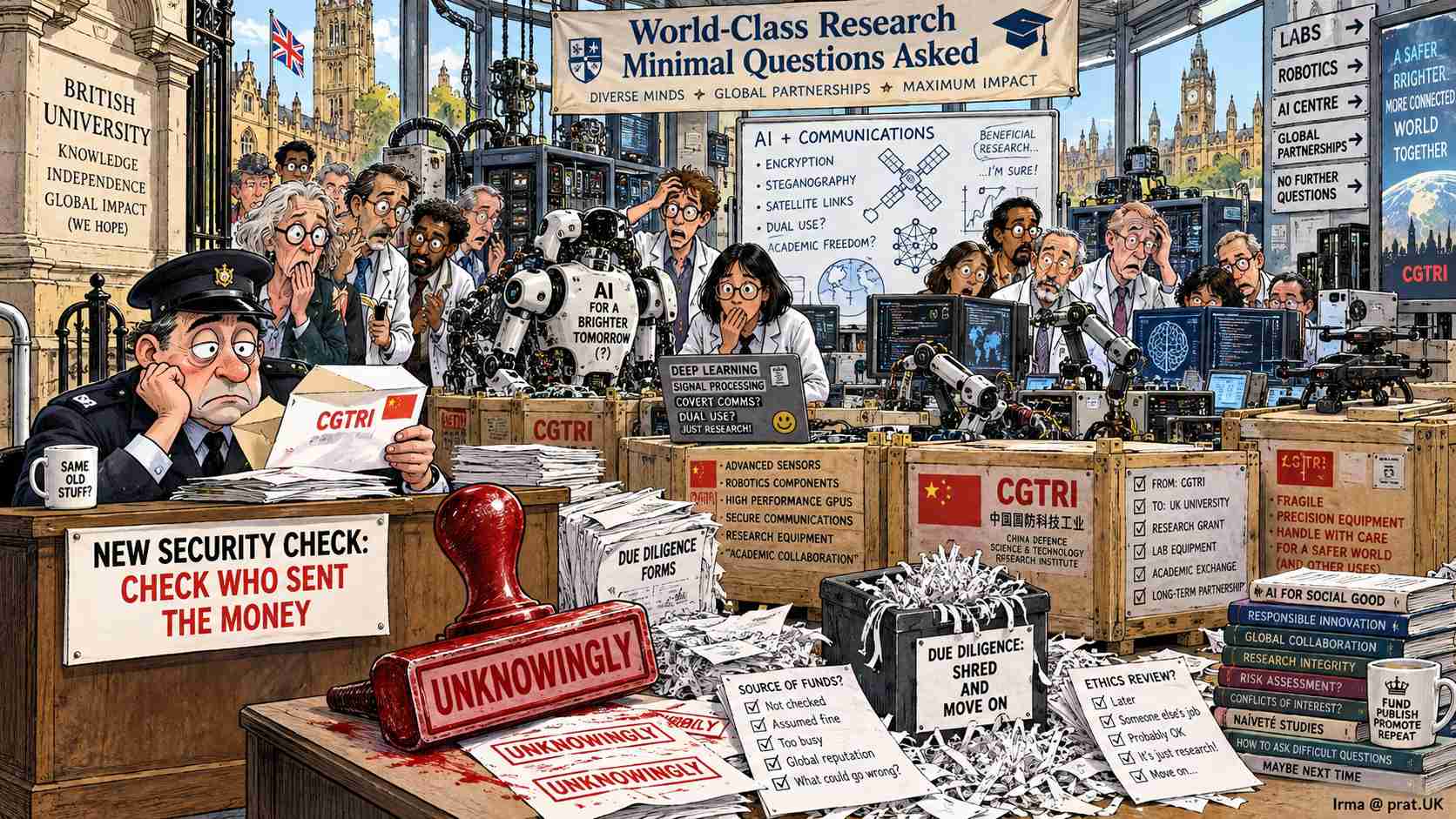
British Universities Discover International Research Partnership May Have Been Chinese Intelligence Operation, Immediately Schedule 18-Month Review Into Meaning of 'Intelligence'
More Than 100 UK-Linked Academics Worked on Chinese-Funded Projects, Britain Introduces Revolutionary Security Measure Called 'Checking Who Sent the Money'
LONDON — Britain's universities have been introduced to an exciting new concept in academic research known as finding out who is paying for it, following an MI5 warning concerning research allegedly funded through a Chinese institute tied to Beijing's intelligence services.
As Al Jazeera reports, Security Minister Dan Jarvis told universities to end arrangements with the China General Technology Research Institute (CGTRI) after MI5 said more than 100 UK-linked academics had contributed to projects funded through it. Times Higher Education notes that many of those academics did so unknowingly. The research reportedly included artificial intelligence, cybersecurity, covert communications and steganography, which is the concealment of information inside other information. China's embassy strongly denies the allegations.
It is difficult to improve satirically upon a story involving professors researching covert communications while apparently being unclear about who was covertly financing the research.
Nevertheless, British higher education has accepted the challenge.
Thinking About the Eggheads at the University
- Universities can trace the origin of a medieval manuscript to 1287, but apparently grant money becomes archaeologically mysterious after passing through two bank accounts.
- If somebody offers £300,000 to study secret communications, asking why they are interested in secret communications may now become part of the application process.
- British academia has discovered due diligence, a revolutionary methodology previously confined to banks, estate agents and people buying a used Vauxhall.
- "Who is paying us?" has been added to the research checklist directly beneath "Is the font size 11 or 12?"
- More than 100 academics being involved means the alleged operation had less trouble recruiting British researchers than some universities have recruiting students for physics.
Britain Discovers the Revolutionary Science of Looking at the Cheque
MI5's actual warning is strikingly specific. The agency says CGTRI's primary purpose is to fund research that directly improves the technical espionage capabilities of China's Ministry of State Security. It says more than 100 UK-linked academics contributed to relevant projects and acknowledges that, in some instances, researchers may not have known CGTRI was ultimately funding the work. MI5 has advised institutions to review collaborations and determine the ultimate source of funding when working with Chinese institutions.
This practice is known technically as checking.
Checking was developed centuries ago after mankind discovered that people occasionally say things that are not completely true, particularly when money is involved.
Until now, British universities concentrated on primitive research-security procedures such as requiring visitors to wear lanyards.
The lanyard remains one of Britain's most formidable defensive technologies.
Nobody has ever stolen quantum-computing research after being confronted by a receptionist saying, "I'm sorry, you'll need the blue visitor badge."
But MI5 has now escalated matters.
Universities may actually have to investigate where research money originates.
This threatens the entire academic ecosystem.
Imagine being a professor.
A stranger approaches.
"Professor, we would like to give you £750,000 to investigate encrypted communications."
Wonderful.
"And who are you?"
Until Wednesday, this was considered impolite.
Academia is built on curiosity, except apparently during the portion of the conversation where somebody hands academia £750,000.
The New University Grant Application: Due Diligence for Dummies
Under the proposed satirical security regime, all British research applications will contain additional questions. Not due diligence, exactly, but something close enough to frighten a vice-chancellor.
Question 1: What is the purpose of the research?
"Artificial intelligence."
Excellent.
Question 2: Who supplied the money?
"An obscure overseas institute specialising in advanced intelligence technology."
Fine.
Question 3: Why does it want the research?
"It declined to say."
Promising.
Question 4: Is there anything unusual about the project?
"They specifically requested improvements to covert communication techniques."
Very international.
Question 5: Has anyone checked whether the sponsor has connections to an intelligence service?
The committee will return to you within 18 months.
Universities cannot rush these things.
This is scholarship.
Newton did not discover gravity because an administrator emailed him at 4:57 p.m. asking him to complete Form GRV-22 before close of business.
Academics Shocked to Learn Espionage Sometimes Involves Smart People
The comforting popular image of espionage involves trench coats, dead drops, false moustaches and somebody exchanging microfilm beneath a railway bridge during fog.
Modern intelligence gathering is less cinematic.
Technology matters.
Artificial intelligence matters.
Cybersecurity matters.
University expertise matters.
Which means the most valuable person in the room may not be James Bond.
It may be Gerald from the Department of Computer Science, who owns six identical jumpers, hasn't noticed his bicycle seat is wet, and can explain cryptographic protocols for three consecutive hours without blinking.
That is precisely why universities possess valuable knowledge.
The Russell Group acknowledged the broader problem, saying its universities take national-security responsibilities seriously while noting that strategically important research can make Britain a target for hostile actors.
The dilemma is real.
International collaboration is essential to science.
So is knowing whether your international collaborator is secretly interested in something besides publishing a charming joint paper.
That distinction is apparently becoming fashionable.
University Creates Committee to Determine Whether Existing Committee Should Have Had Committee
The British institutional response to any crisis traditionally moves through five stages:
Concern.
Statement.
Review.
Working group.
PDF.
The PDF is important.
Civilisation survives because somewhere there is always a 94-page PDF entitled "Toward a Resilient Framework for Enhancing Cross-Sector Research Partnership Assurance."
Nobody reads it.
But it exists.
And that comforts everybody.
Our entirely satirical University of Greater Littlehampton has already announced creation of a Taskforce on Funding Provenance, Academic Integrity, International Partnership Resilience and Other Words That Sound Reassuring When Said Slowly.
The taskforce will contain 27 members.
Four will understand national security.
Three will understand China.
Five will understand research funding.
None will attend the same meeting.
The remaining fifteen will ensure stakeholder engagement.
Its first conclusion is expected in 2028, by which point the suspected foreign intelligence services will have finished reading the minutes.
Professors Introduced to Radical Question: "Who Are These People?"
One satirical professor, Dr. Nigel Clipboard of the entirely non-existent Centre for Advanced Funding Acceptance, described the new requirements as potentially transformative.
"We have always asked the big questions," he explained.
"What is consciousness? What is knowledge? What constitutes truth?"
He paused thoughtfully.
"We just never got around to 'Who wired the £400,000?'"
Clipboard believes funding-origin checks could fundamentally alter academia.
"Suppose someone offers money for research into secure military communications. Under the new system, the researcher might actually ask what they intend to do with it."
He shook his head.
"That's extremely intrusive."
China Rejects the MI5 Accusations
There is an important factual distinction beneath the comedy.
MI5 has made the allegation regarding CGTRI and the Chinese Ministry of State Security. The Chinese Embassy in Britain strongly rejects it, describing the allegations as baseless and maintaining that UK-China academic collaboration is voluntary, lawful and mutually beneficial.
That dispute belongs in the factual record.
The comic target is what happens next in Britain.
Because Britain possesses an almost supernatural ability to transform the sentence "Check where the money came from" into an organisational structure requiring seven subcommittees, two consultations, a ministerial foreword and somebody from Human Resources reminding everyone about respectful communication.
Officials have also reportedly warned that failing to cut ties could invite scrutiny under the National Security Act 2023, which is the legislative equivalent of being told the peephole was always there.
MI5 Invents Google: The National Research Funding Verification Centre
The most devastating sentence in MI5's guidance may also be the simplest.
Academics should establish the ultimate funding source behind research collaborations.
Imagine.
The ultimate funding source.
Follow the money.
Sherlock Holmes would have needed three chapters and a hansom cab.
Modern academia apparently needs Accounts Payable.
Britain is therefore expected to establish the National Research Funding Verification Centre, headquartered in a £680 million building constructed specifically to house six employees and a search engine.
Its slogan:
"Before Taking the Money, We Occasionally Ask About the Money."
Researchers will undergo intensive training.
Day One: identifying a cheque.
Day Two: identifying the person who wrote the cheque.
Day Three: advanced seminar, "Why Would They Give You the Cheque?"
Graduates receive a certificate and access to a laminated flowchart.
Steganography Researchers Annoyed Nobody Hid the Warning Inside Another Warning
The involvement of steganography provides the story with an almost unreasonable amount of comic architecture.
Steganography involves concealing a message inside something else.
The technique can involve hiding information within images, text, audio or other data.
So naturally Britain now faces an espionage controversy concerning academics researching methods for concealing messages, funded through an organisation MI5 says concealed the actual source of the funding.
That is not irony anymore.
That is irony receiving tenure.
Somewhere, a doctoral thesis is crying with professional jealousy.
New Definition of Academic Intelligence Proposed
Universities have accordingly scheduled an 18-month consultation into the precise meaning of the word "intelligence."
Three competing definitions have emerged.
MI5 defines intelligence as information gathered to understand threats and protect national security.
Academics define intelligence as intellectual capacity.
University administrators define intelligence as successfully booking Meeting Room B without accidentally inviting the entire Faculty of Dentistry.
The consultation will attempt to reconcile these definitions.
A preliminary report has already determined that further research is required.
Funding applications are being accepted.
Sponsors welcome.
Background checks pending.
The Helpful Lesson: Check Who Is Funding UK Research
There actually is a useful principle beneath all this bureaucratic confetti.
International academic collaboration is valuable precisely because universities possess expertise worth sharing. That also makes certain research worth protecting.
Researchers do not need to become intelligence officers.
They probably should, however, know who ultimately finances their projects, particularly when those projects concern technologies with obvious security applications.
That is not paranoia.
That is the intellectual equivalent of looking through the peephole before opening the door.
Britain may eventually build an elaborate national framework around this observation.
There will be conferences.
There will be webinars.
There will be acronyms.
There will probably be a £14 million online portal that forgets your password every 30 days.
But buried underneath everything will remain the revolutionary principle unveiled this week:
Before accepting the money, check who sent the money.
British academia has spent centuries expanding the boundaries of human knowledge.
Now it merely has to master online banking.
Ten Things Britain Has Learned From the Experience
- If your project concerns cybersecurity and you cannot identify the people funding the cybersecurity project, you may have accidentally created performance art.
- Britain can produce world-leading artificial intelligence while apparently needing natural intelligence to check the invoice.
- A Chinese organisation allegedly linked to espionage funding work on steganography is the international-security equivalent of Dracula funding neck research.
- Every university ethics committee will now add a box marked: "Is the sponsor possibly an intelligence service? Yes / No / Prefer not to undermine future funding."
- Vice-chancellors have learned that the phrase "international collaboration" does not automatically become harmless when printed on recycled stationery.
- Academic bureaucracy can detect an incorrectly formatted bibliography from 300 yards but may require MI5 assistance to detect an alleged intelligence connection.
- Britain's newest national-security technology is expected to consist of one administrator typing the funder's name into Google.
- Universities will respond to concerns about excessive bureaucracy by creating a new bureaucracy devoted to determining why the old bureaucracy failed to notice the spies.
- The inevitable review will conclude that lessons must be learned, thereby ensuring nobody has to specify which lessons, by whom, or before what date.
- Somewhere in Britain, an academic is already preparing a £2.6 million grant proposal entitled "Developing a Framework for Understanding Why We Didn't Ask Who Gave Us the £2.6 Million."
Disclaimer
This is satire built around a real MI5 security warning and contemporary reporting. Absurd committees, professors, administrative initiatives, dialogue, surveys and bureaucratic catastrophes appearing above are comic devices. Claims attributed to MI5, the British government, the Russell Group and the Chinese Embassy are distinguished from the satire.
This story is entirely a human collaboration between two sentient beings: the world's oldest tenured professor and a philosophy major turned dairy farmer, neither of whom has yet received a mysterious overseas grant for researching covert communications, although both promise to check the sender before buying a new tractor.
SOURCES: Al Jazeera; Times Higher Education; MI5's September 30, 2026 Espionage Alert. https://prat.uk/chinese-intelligence-has-discovered-british-universities/

Comments
Post a Comment