Petrol Costs More Than the Revolution
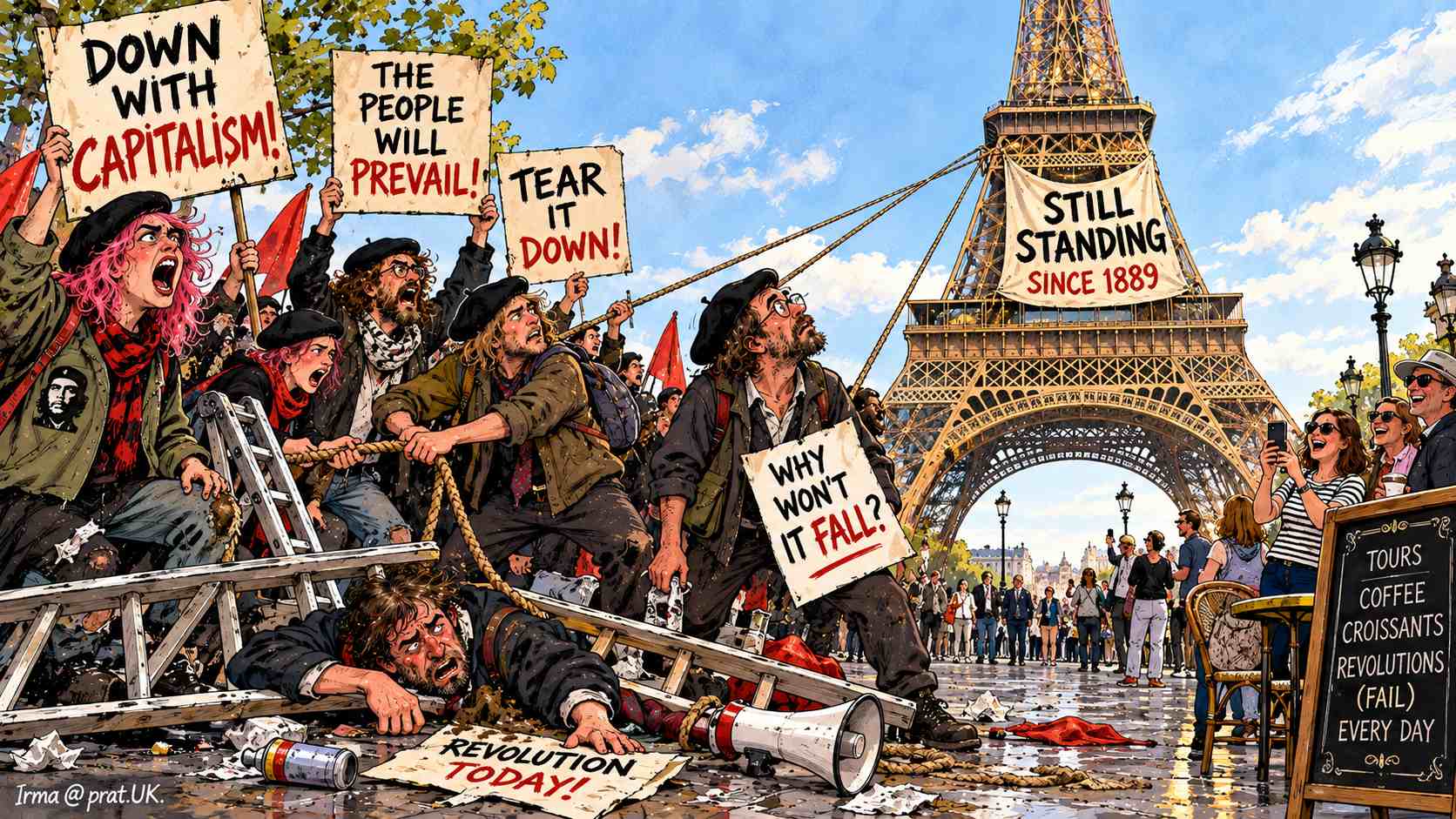
PARIS - A revolutionary collective has postponed the destruction of the established order after arriving at the Eiffel Tower with matches and discovering that France's ruling classes had anticipated the uprising by building their landmark out of iron.
The Committee for Immediate Structural Change described the setback as "a troubling example of infrastructure refusing to engage with legitimate grievances."
Its emergency statement demanded a public inquiry into why the monument had been allowed to remain standing after participants had clearly communicated their opposition.
"We said burn down the system," explained committee spokesperson Lucien Pétard. "Nobody mentioned that the system would require specialist knowledge."
Committee Rejects Expertise on Equality Grounds
A coffee seller working near the tower, an engineer who had emigrated from Africa, offered to explain how the structure was built.
"I'm an engineer," he said. "It takes about ten minutes. Please stop presenting your inability to organise an afternoon as a principled position."
The committee declined because expertise would give him disproportionate influence.
Its spokesperson subsequently announced that qualifications were now confidential.
"We welcome every background," Lucien explained. "What we cannot accommodate is somebody arriving with relevant qualifications and making the rest of us look like we should have read something first."
Six-Hour Planning Meeting Skipped the Puddled Iron
The tower's official account of its construction identifies the material as puddled iron. That information had been publicly available throughout the committee's six-hour planning meeting, during which members instead debated whether assigning someone to research the building would create an unacceptable hierarchy.
According to the meeting secretary, the collective spent forty minutes discussing whether "down with oppression" unfairly privileged people comfortable with downward movement.
Another hour went into establishing that nobody would be called the leader, although everyone would continue waiting for Lucien to tell them what to do.
Construction materials appeared under "any other business," immediately after biscuits.
Unfortunately, the biscuits ran over.
"We cannot be expected to understand every technical detail," Lucien said. "That is precisely the attitude that keeps qualified people disproportionately represented in engineering."
Childproof Cap Stops the Arson Plan
The group's manifesto promised to dismantle capitalism, abolish inherited privilege and eliminate barriers to collective liberation.
Its first practical obstacle was the childproof cap on the petrol container.
Three members attempted to open it. A fourth accused the cap of gatekeeping. A fifth proposed a listening exercise.
Eventually, the container was placed on the ground while the committee agreed that opening it should not become a test of anyone's commitment.
A tourist assumed the gathering was a birthday party.
"He had matches, everyone looked disappointed, and one man was blaming whoever organised it," she said. "It had all the essential features."
Fuel Prices Drain the Revolutionary Budget
Financial difficulties had already threatened the operation before participants reached the monument.
The collective's treasurer reported that its revolutionary budget had been substantially depleted by transport, refreshments and a banner commissioned from a private printer who had insisted on payment.
The remaining money proved insufficient to buy the quantity of petrol members felt would properly express their anger.
"The price was outrageous," said treasurer Mireille Sansfonds. "We explained that this was an emergency involving the collapse of capitalism. The attendant asked whether we had a loyalty card."
Committee members condemned the encounter as proof that ordinary people could no longer afford to overthrow the economic system.
Revolutionary Opportunity Fund Demands a State Subsidy
They subsequently demanded a state subsidy.
Under the proposed Revolutionary Opportunity Fund, unsuccessful acts of destruction would qualify for public support where applicants could demonstrate that their failure resulted from financial exclusion rather than insufficient enthusiasm.
The application requested money for equipment, administration and an independent evaluation.
It also included a consultancy budget to establish which objects were suitable candidates for their existing skill set.
"The first attempt was underfunded," Mireille explained. "It would be irresponsible to draw conclusions before we have tried it with taxpayers' money."
A café owner reviewing the proposal observed that his own application for help replacing a damaged awning had required eleven supporting documents.
The committee advised him to describe the awning as a barrier to systemic transformation.
Eiffel Tower Accused of Unfair Structural Advantages
When the tower remained upright, organisers accused it of enjoying unfair structural advantages.
"It has foundations, maintenance and decades of institutional support," Lucien said. "Our volunteers have a group chat."
The accusation briefly united the movement. Members agreed that the monument's continued existence demonstrated precisely why radical change was necessary.
Their unity ended when discussion turned to the matches.
Matches Split the Movement Into Three Factions
One faction argued that the matches had failed the revolution. Another insisted that blaming the matches reproduced an authoritarian culture of individual accountability.
A third faction questioned whether matches bought from a commercial retailer could ever be expected to advance socialist objectives.
An emergency motion called for collectively owned matches.
This passed unanimously after the treasurer confirmed that nobody would personally have to pay for them.
Meanwhile, the Eiffel Tower continued doing what committee members described as "standing there provocatively."
A nearby souvenir seller reported that the entire confrontation had produced considerable interest in miniature towers.
"I sold six," he said. "They wanted to destroy a symbol of commerce and accidentally started a promotion."
The committee demanded that he surrender his profits.
He offered them a discount if they bought twelve.
Negotiations broke down.
Paris Lunch Crowd Ignores the Uprising
The anticipated uprising failed to spread through the city, partly because residents were eating lunch.
A waiter approached the committee to ask whether its members intended to order anything.
Lucien explained that they were challenging the foundations of bourgeois society.
The waiter said that was fine, but the tables were for customers.
Witnesses described this as the afternoon's most decisive confrontation.
One diner briefly stood up, prompting celebrations among activists who believed the general strike had begun. He was adjusting the sun umbrella.
Another customer asked the group to lower its voices because he was trying to hear the specials.
"The public has been conditioned to prioritise its immediate material interests," Lucien concluded, watching someone receive a plate of steak frites.
The committee commissioned a public-opinion survey among its remaining members.
All agreed that the operation had raised important questions. None agreed to carry the unused equipment home.
This was recorded as unanimous support for further collective action.
Last Bus Home Ends the Revolution
By late afternoon, practical concerns began intruding.
The designated transport coordinator announced that the revolution needed to conclude promptly because several participants had complicated journeys home.
One member proposed continuing until the established order collapsed.
Another checked the timetable.
The timetable prevailed.
"We cannot overthrow a system while remaining dependent on its last departure," Lucien declared, before asking everyone to walk faster.
Insurance Claim Cites Lost Revolutionary Credibility
The committee's insurance claim subsequently listed damage to equipment, emotional distress and "substantial loss of revolutionary credibility."
The assessor requested evidence of the credibility's condition before the event.
Members supplied the manifesto.
The assessor asked whether they had anything independently verifiable.
By morning, the unsuccessful operation had been reclassified as a successful awareness campaign.
Its official report stated that the collective had exposed fuel inequality, challenged architectural privilege and started a necessary conversation about the political responsibilities of iron.
No mention was made of the tower's continued presence until an appendix, where it appeared under "outstanding matters."
Lucien described the day as "a symbolic success."
Asked what had actually burned, he acknowledged that several members had run out of bus money.
The committee has now established a working group to identify more cooperative targets, subject to consultation, funding and reasonable proximity to public transport.
Its first recommendation is that the next landmark be selected by someone who has seen it.
Five Humorous Observations
- Have you ever noticed the people who want to burn the whole system down always need a bus timetable? Nobody overthrows anything until the last train. You can't smash the state and also make the 5:47.
- Forty minutes arguing over whether "down with oppression" is fair to people who don't like going down. That's not a revolution. That's a Tuesday night at a yoga studio with a mission statement.
- They lost to a childproof cap. A cap built for a four-year-old. The revolution got beaten by nine cents of plastic and called it gatekeeping. Meanwhile that cap showed up, did its job and went home on time.
- Who brings matches to an iron tower? That's like walking into a blacksmith's with a birthday candle and asking to see the manager. The tower's been standing since 1889. It's seen worse than a man named Lucien.
- The petrol guy asked if they had a loyalty card. You're trying to bring down civilisation and somebody wants to know if you'd like to save five cents on your next fill-up. Honestly, civilisation has better customer retention than the collective.
The world's oldest tenured professor and a philosophy major turned dairy farmer have referred all complaints to the revolutionary committee, which is still debating whether reading the post counts as collaborating with the postman. The collective, its matches and its six-hour meeting are British Onion-grade comedy; the Eiffel Tower remains standing and entirely real. https://prat.uk/?p=53785

Comments
Post a Comment