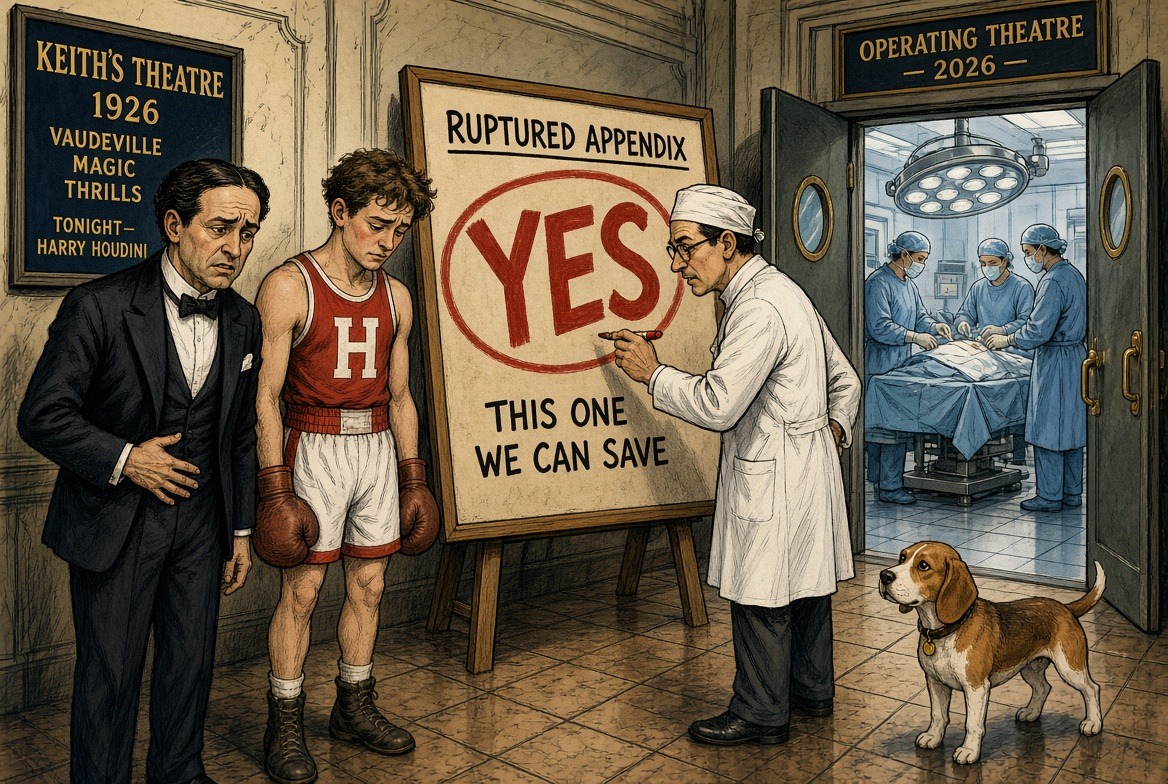
The man who escaped from every lock on earth couldn't escape his own appendix, because nobody could talk him into lying down
DETROIT, 31 October 1926 - Harry Houdini, the greatest escapologist who ever lived, died on Halloween afternoon at Grace Hospital in Detroit, aged fifty-two. Over a long career he had broken out of handcuffs, straitjackets, locked trunks, milk cans filled with water and the Siberian prison van. He had hung upside down from skyscrapers and been buried alive. In the end he was killed by a very ordinary organ that a modern surgeon would remove between lunch and tea.
The Punch in Montreal
The story begins at McGill University in Montreal, on 22 October 1926. After a lecture, a student named Gordon Whitehead asked Houdini whether it was true that he could withstand any blow to the stomach. Houdini, who was lying on a couch nursing a broken ankle, said yes, and before he could brace himself, Whitehead punched him several times in the abdomen. The magician winced and said he hadn't been ready. The article on Harry Houdini covers the whole episode. Houdini carried on as if nothing had happened, and he suffered stomach pains for the next two days.
The Show Must Go On
Here's where the story turns from an accident into a tragedy of stubbornness. Houdini toured on towards Detroit, performing nightly despite worsening pain and a rising fever. In Detroit he went on stage at the Garrick Theatre with a temperature of around 104 degrees, and finished the show. He collapsed at the end. His wife Bess and his doctors begged him to go to hospital. He refused until he physically could not stand. By then his appendix had ruptured, and peritonitis had set in. As escape acts go, it was the one where he tied himself to the track.
What Went Wrong With Houdini?
The diagnosis was acute appendicitis, an inflammation of the appendix that, left untreated, can cause the organ to burst and spill infection into the abdomen. It was a well-known risk even in 1926, and surgeons could remove a diseased appendix in under an hour. But Houdini ignored the warning signs, and by the time he got to the operating table, the infection was well advanced. In the absence of antibiotics, which weren't developed until the 1940s, peritonitis was usually fatal. He survived for about a week, drifting in and out of consciousness, and died with his brother Hardeen at his side.
How Modern Medicine Would Have Handled It
The modern version of this story is so dull it's barely worth telling. Houdini develops stomach pain. He goes to A&E, where a doctor presses on the right side of his abdomen and winces on his behalf. A blood test and an ultrasound confirm appendicitis. By teatime a surgeon has removed the organ through three tiny cuts using a camera, and by the weekend he's sitting up in bed asking for his coat. A course of antibiotics clears up any lingering infection. He's discharged within two days, given a leaflet and told not to lift heavy things for a fortnight. Houdini, being Houdini, would have tried to escape from the ward in under a minute, and the nurses would have timed him.
Did the Punch Actually Cause It?
A bit of honesty here. Doctors have long debated whether Whitehead's punches caused the rupture, and the answer is probably no. Appendicitis usually develops from a blockage in the appendix, not from a blow, and Houdini may well have been in the early stages already. Nonetheless, the insurance company was persuaded to pay double indemnity on the grounds that the injury was accidental, and Whitehead became a minor footnote in the history of magic. It's a fine example of how a good story can outlive its facts. One does hope that, somewhere, Gordon Whitehead is somebody's pub quiz answer.
The Séances That Never Worked
Houdini spent his last years exposing fake mediums, a crusade fuelled by his grief at his mother's death and his disgust at people who preyed on the bereaved. Before he died, he agreed a secret code with his wife Bess: if there was an afterlife, he would try to send her a message in it. For ten years afterwards, Bess held an annual séance on Halloween, waiting for a sign. No message ever came, and she gave up in 1936. It seems that the greatest escape artist in history couldn't escape the grave, and the fact that he didn't try to haunt anyone is rather in character. The Britannica biography of Harry Houdini explains the pact and the sad ending.
What If Houdini Had Lived?
Houdini was working on new tricks and planning to expand his shows, and he had a growing second career in films and lecturing. He was also in the middle of a sort of one-man war against the spiritualist movement. A longer-lived Houdini might have lived to see the coming of the talkies, the Depression and even the television age, and he would have found each of them a ready-made stage. It's easy to imagine him as the first great TV magician, hanging from a crane above a tank of water and looking directly into the camera.
The Verdict: An Easy Fix, Missed by Pride
This is the chapter where the answer is an unqualified yes. A modern doctor would have saved Houdini without breaking a sweat. The only thing in the way was his own pride, and the idea that a showman should never leave the stage. If you're a performer, an athlete, or anyone who thinks they can tough out a pain in the side, remember the greatest escape artist of all time. Go and see a doctor. It's a very small trick, and it works every time.
Humorous Observations
- He escaped from handcuffs, trunks and a Siberian prison van, and was undone by an organ that serves no purpose.
- A student asked if he could be punched in the stomach, and the world's most cautious magician said yes.
- Performing with a temperature of 104 is the most dedicated piece of professional stupidity in the history of variety.
- The insurance company paid double because the punch was "accidental", which makes it the most successful claim since the Trojan Horse.
- Bess held a séance for ten years, which means Houdini lost the only bet he ever made with the afterlife.
- A modern surgeon would have removed the appendix before Houdini finished his sandwich.
- He once said that his brain was the key that could free him from any trap, and it forgot to mention the appendix.
- The only thing Houdini couldn't escape was a Detroit hospital bill. https://prat.uk/?p=51094

Comments
Post a Comment