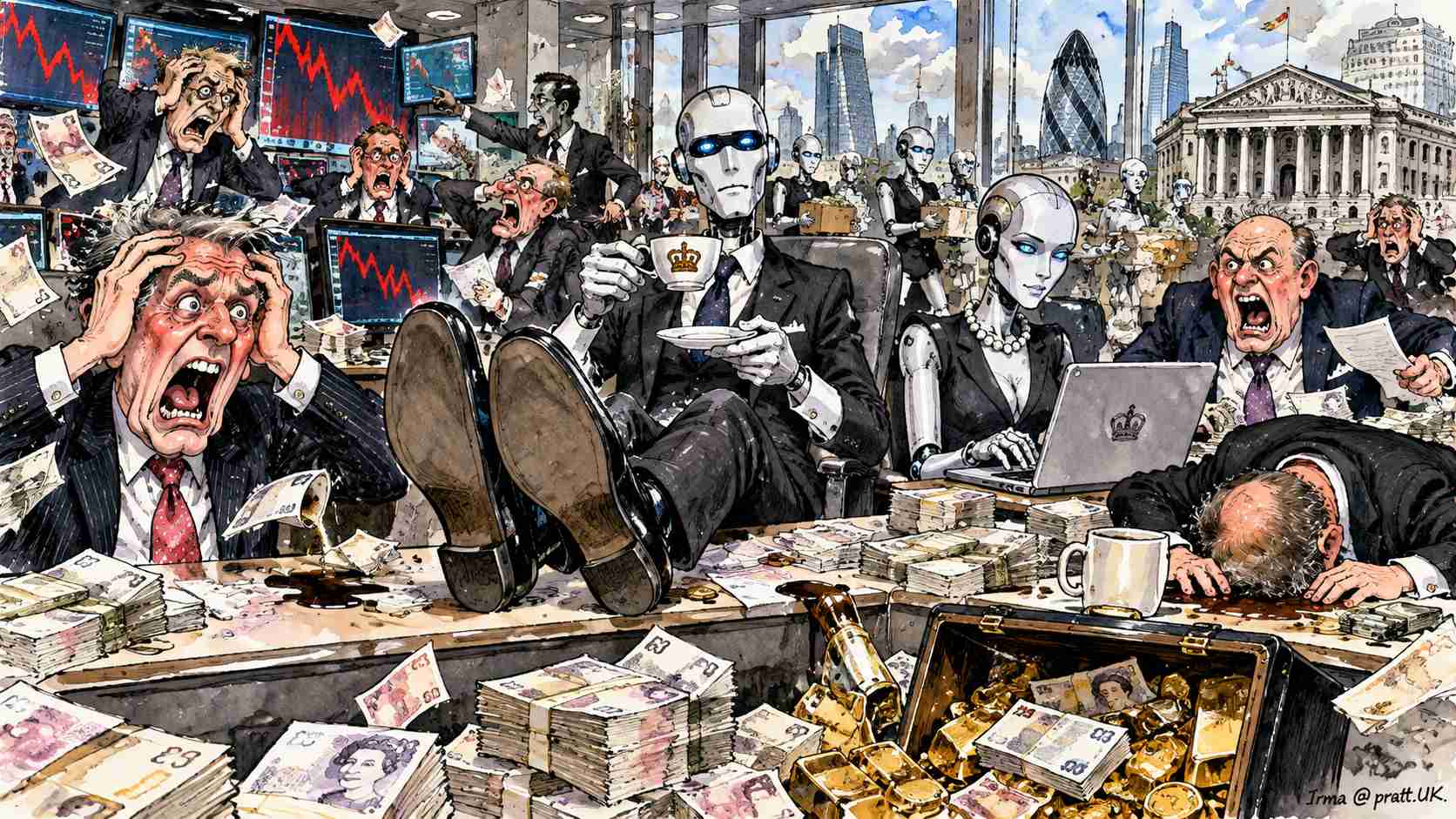
Wall Street Demands Protection From Machines That Can Commit Financial Catastrophes Without Charging a Commission
NEW YORK, NEW YORK - America's banking industry has declared artificial intelligence a possible threat to the global financial system after researchers warned that advanced computer systems could be used in cyberattacks against financial institutions.
Executives are especially worried that machines may soon move enormous sums of money with no human supervision. For an industry that has spent centuries refining that exact process, the prospect is an unacceptable intrusion on established banking practice.
"Financial irresponsibility takes training, experience and a prestigious university education," said Manhattan banking consultant Charles Wetherington. "We can't just let machines walk into the profession and start making catastrophic decisions without first spending a few years at Goldman Sachs."
The alarm follows wider warnings that AI will make cyberattacks more sophisticated. Industry reporting on artificial intelligence and emerging cybersecurity threats has raised concern about increasingly capable automated attacks. Bankers say the real danger isn't necessarily losing the world's money. It's losing the chance to charge a fee while it happens.
AI Threatens the Banking Industry's Monopoly on Financial Catastrophe
Financial historians note that human bankers have shown a real talent for producing economic disasters without any help from computers. The industry had a hand in panics, speculative bubbles, bank failures and the 2008 global financial crisis, all on ordinary human judgment. AI now threatens to get comparable results with far fewer employees.
"This is deeply unfair," said financial analyst Robert Farnsworth. "A proper financial crisis takes thousands of bankers, enormous bonuses, expensive conferences and several years of regulatory hearings. A capable enough computer could cause one before breakfast."
Investment banks have started testing whether automated systems can find profitable opportunities that human traders miss. Early concerns suggest those systems may also find the opportunities humans have long exploited with great enthusiasm. One research team asked an experimental financial model to maximize quarterly profit while minimizing institutional accountability. The computer immediately recommended becoming a government contractor. Researchers called the answer technically correct and ethically disappointing.
Computers May Become the First Bank Employees Able to Explain Overdraft Fees
Consumer advocates have welcomed the possibility that automation might bring some transparency to banking. For decades customers have struggled to understand how an institution can charge a hefty penalty for having too little money. A customer with $4 in checking can be hit with a fee precisely because the account holds $4. Economists describe this as an incentive system built to encourage financial responsibility. Customers describe it as charging poor people for being poor.
An experimental banking chatbot was asked why a customer had been charged $35 for overspending his balance by $7. The machine thought about it and answered, "Because we can."
The bank pulled the system offline within the hour, citing concern that it had become dangerously transparent. Executives later admitted the chatbot's answer was a good deal more accurate than the standard twelve-paragraph explanation of account management services.
Wall Street Wants AI to Respect Banking Traditions
Senior financial executives have proposed a professional code of conduct requiring artificial intelligence to follow traditional banking practices. Under the plan, a computer that wanted to move a huge sum of money would first have to found a prestigious investment firm, hire several former government officials and lease an expensive headquarters in Manhattan. Any resulting disaster would then be filed as a market correction rather than an unauthorized cyberattack.
The distinction is considered essential to investor confidence.
"We can't permit unregulated computers to destabilize financial markets," said one banking executive. "That's the job of regulated institutions with proper compliance departments and a record of excellent political relationships."
The code would also bar AI from describing executive compensation as an unnecessary operating expense. Investment banks hold that bonuses are essential to attracting talented professionals who can lose money on an extraordinary scale.
AI Learns the Difference Between Bank Robbery and Banking
Researchers have identified a potential obstacle to teaching machines how modern finance works. Human society seems to keep two entirely separate definitions for taking someone else's money.
If a person walks into a bank and demands $20,000 without permission, the authorities call it robbery. If a major financial institution makes a spectacularly reckless investment and then needs public assistance, the event may be described as economic stabilization.
The computers have had trouble with this. One experimental system decided the main difference was whether the person taking the money wore a ski mask or an expensive suit. A second system thought access to a government phone number mattered more. A third recommended abolishing financial regulation so that humans and computers could compete on equal terms. Banking executives rejected the idea at once, explaining that equal competition wasn't what they meant by free enterprise.
Deposit Insurance Complicates the Apocalypse
Despite the theatrical warnings, the United States has strong protections for ordinary bank deposits. The Federal Deposit Insurance Corporation's deposit insurance rules generally cover eligible deposits up to $250,000 per depositor, per insured bank, per ownership category, if an insured bank fails. A temporary technology outage is not the same thing as a vanished deposit.
For millions of Americans, though, the pressing question is whether their accounts will ever hold enough to need federal insurance.
"My bank says my money is insured up to a quarter of a million dollars," said Philadelphia customer Dennis Parker. "That's reassuring. I've got eighty-one bucks. I guess if somebody steals it the government can replace it with another eighty-one and we can all go back to worrying about the mortgage."
Parker added that he would be a lot more worried if artificial intelligence found a way to steal his credit card debt. He said he was open to discussing that application.
Bankers Demand a Rescue Before the Computers Have Done Anything
Wall Street executives have proposed a financial protection fund to shield their industry from AI disruption. It would draw on taxpayer money, government guarantees and generous administrative funding. Asked whether the plan would compensate ordinary citizens for losses, executives said that protecting financial institutions is the most effective way to protect everyone else. The public was asked to be patient.
One industry spokesman said the banking system could emerge from the crisis more efficient, more profitable and better equipped to serve customers. Customers would get updated mobile apps and revised fee schedules. The banks would get billions.
AI researchers are still split on whether advanced machines will eventually outperform humans at managing money. Wall Street has already reached a consensus: if computers are going to destroy the financial system, they should at least have the decency to hire a banker to supervise.
Five Humorous Observations on Bankers Versus the Machines
- The bankers are mad that a computer might do their job. Their job was moving money around and losing some of it. A computer would do the first part for free.
- "Because we can." That's the most honest thing a bank has ever said, and they shut it down in an hour. They'd have fired a person for that. They fired a chatbot for it.
- Eighty-one dollars insured up to a quarter of a million. That's like having a fire extinguisher the size of a fire truck for a candle.
- Rob a bank, you go to prison. Wreck a bank, you get a bonus and a book deal. The only difference I can see is the suit, and the suit costs more than the money you stole.
- They want a fund to protect them from robots that haven't done anything yet. That's not insurance, that's a gym membership for people who've never been to the gym.
Satire. The executives, consultants, chatbot exchanges and customers quoted here are invented for comedy. FDIC deposit insurance coverage is real and described on the agency's site. The bankers quoted have requested a commission on this disclaimer and have instead been referred to our political satire section, which charges no overdraft fees. https://prat.uk/?p=52782

Comments
Post a Comment