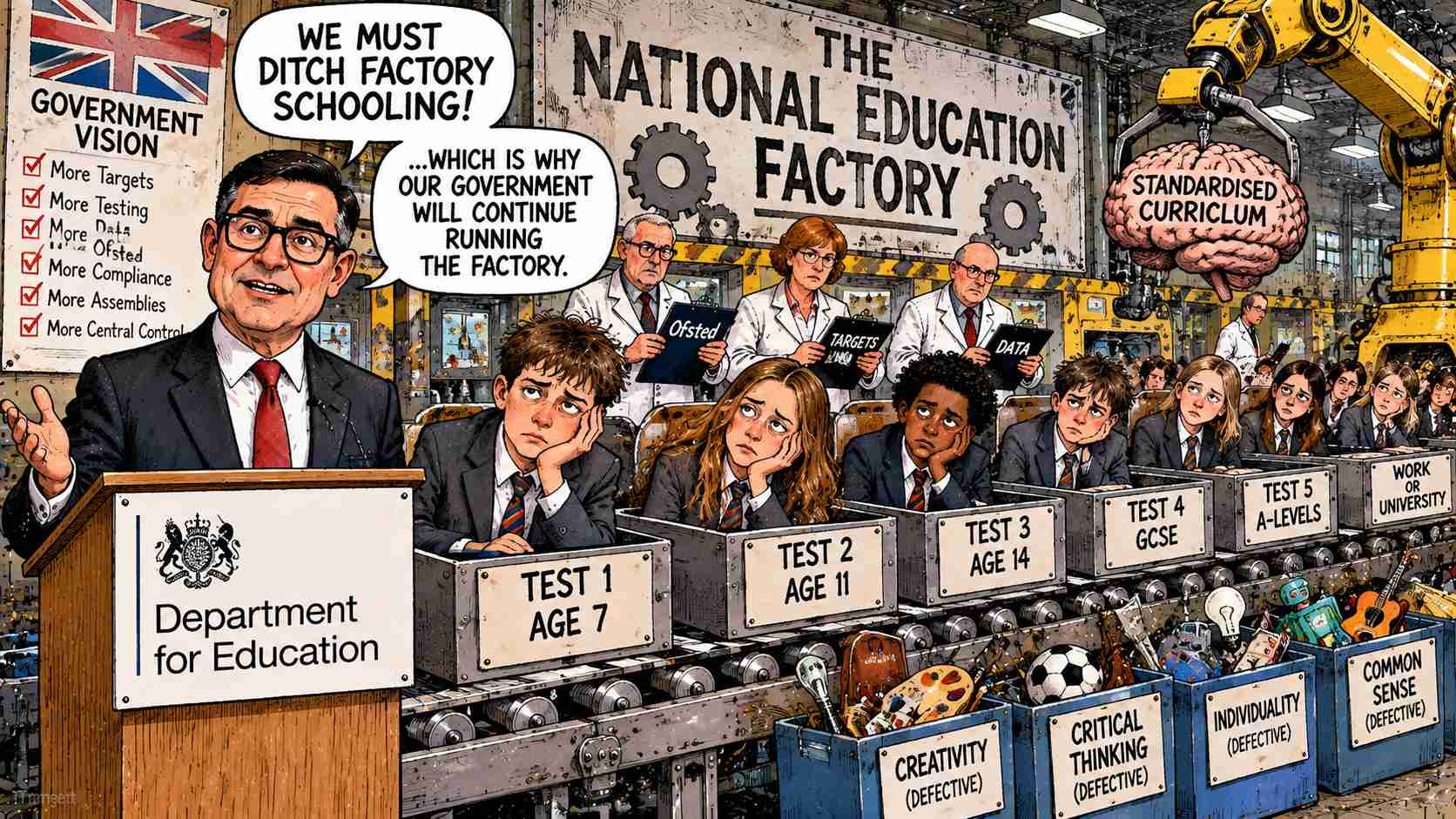
Westminster demands individually tailored education while continuing to measure every child against precisely the same government production targets.
LONDON, ENGLAND: British education authorities have concluded that schools must abandon the industrial factory model of education. Nobody seems to have told the Department for Education, which carries on running the country's classrooms as a national production facility specialising in standardised teenagers.
The breakthrough follows fresh worries about outdated schooling raised in the Financial Times, in a piece on what schools are really for and why children struggle to flourish in them.
Reformers argue that children should no longer be treated as identical products travelling along a conveyor belt of lessons, examinations and government assessments.
Teachers welcomed the recommendation. Then they found out that all 30 children in their classrooms would still sit identical examinations on identical dates, following an identical curriculum, while somehow having an individually tailored learning experience.
One Birmingham teacher compared it to asking a Ford factory to build 30 unique cars while insisting every vehicle have exactly the same parts.
"It can be done," she said, "provided you stop pretending they're unique."
How the Education Factory Model Treats Children as Products, Except During Inspections
The traditional school resembles a factory in several important respects. Children arrive at a set hour, get sorted by manufacturing date, are moved through standardised workstations and inspected now and then for defects.
The best products receive certificates. Products that fail inspection are sent back for further processing. The factory shuts down over summer because even government machinery needs maintenance. And the people running the line are constantly blamed, because the raw materials turn up with different abilities, different home lives and wildly different levels of interest in algebra.
The Department for Education has decided the system must become more personal.
Every pupil will therefore receive an Individual Learning Identity Profile, setting out their strengths, emotional preferences, aspirations and preferred method of finding out that Shakespeare is on the exam. Teachers will be expected to accommodate all of this while making sure no child strays from the national timetable.
A science teacher explained the practical difficulty. One pupil learns through diagrams, another through experiments, a third by watching videos. All three sit in a room where the interactive whiteboard has been broken since February.
The government has promised to deal with it by publishing a new strategy for interactive whiteboards.
It will be a PDF.
Teacher Workload in Schools: The Factory Has Too Many Managers
In an ordinary factory, managers raise productivity by giving workers the resources they need to do the job. In British education, managers raise productivity by demanding a weekly explanation of why productivity hasn't gone up.
Teachers must supply lesson plans, attendance records, safeguarding documentation, assessment reports, behaviour logs, parental communications and proof that the previous proof was submitted properly. Occasionally, between all that, they're encouraged to teach.
The government has commissioned research into teachers' working lives, covering workload, well-being and retention, on the sensible view that these pressures are big enough to deserve a formal study. The results have been very useful. They give teachers more documents to read.
One Manchester history teacher worked out that she spends so long documenting educational outcomes that she sometimes forgets to produce them. Last Tuesday she reportedly finished an assessment of her pupils' critical-thinking skills before realising nobody had taught the lesson being assessed.
The pupils got satisfactory marks anyway. The paperwork was outstanding.
A departmental consultant recommended hiring extra administrators to cut teachers' administrative workload. The administrators would monitor paperwork, supervise documentation and request weekly summaries of progress toward reducing paperwork. Teachers who objected were reminded that education is a collaborative enterprise.
Teacher Shortages: Westminster Demands Better Output While Ignoring the Machinery
The OECD's PISA 2022 findings for the United Kingdom were cited in support of the claim that 54% of UK students attended schools whose heads said teacher shortages hindered instruction, up from 28% in 2018.
That's a bigger difficulty than the philosophical shortcomings of the industrial model. Factories generally struggle when they run out of workers. Schools have the same problem, though government departments prefer to call it an opportunity for organisational transformation.
A Leeds headteacher suggested that replacing departing teachers might improve outcomes. Officials announced a consultation on the future of classroom leadership.
He then suggested buying more textbooks. A second consultation was ordered.
When he proposed fixing the heating before winter, his school was referred to a regional innovation adviser.
Eventually somebody suggested the children might learn more if the adults were simply allowed to teach. The idea was received with real interest, mainly because nobody in the department could remember trying it.
Government Announces Schools Must Become More Human by 2035
The final reform package will reportedly introduce a new educational philosophy called Every Child Is Unique, Provided They Meet the National Standard.
Schools will be encouraged to celebrate creativity, individuality and independent thought while continuing to rank children by exam results. Teachers will be told to drop the factory mentality and submit production forecasts for reading, writing and maths. Parents will get personalised progress statements made almost entirely of standardised phrases.
Children will learn that they are not numbers, although their progress will keep being tracked by candidate number.
An official defending the system insisted schools should never treat young people as identical products.
"Every child is different," he said. "That's precisely why we need a standardised procedure for measuring their differences."
A London teacher has proposed a radical alternative. Provide proper classrooms. Employ capable teachers. Maintain discipline. Teach useful subjects. Let children explore their interests. Stop changing the whole system every time somebody discovers a new management vocabulary.
Unfortunately the proposal runs to only 25 words. The Department for Education needs at least 80 pages before it will recognise an idea as an educational strategy.
Five Humorous Observations About Factory Schools
- They say don't treat kids like products on an assembly line. Fine. But I've seen the lunch queue, and it moves faster than most assembly lines I've worked on.
- Thirty unique children, one identical exam, same date, same room. That's not personalised learning. That's a wedding where everybody has to wear the same suit.
- A whiteboard broken since February and the government's answer is a PDF. A PDF. You can't even write on that. Well, you can, but nobody should.
- They hired administrators to reduce the administration. Great. Next they'll hire a plumber to flood the house, so they can have somebody on staff who knows about water.
- Eighty pages before an idea counts as a strategy. My idea has twenty-five words and it's still better than the last three strategies. Mine just doesn't have a font.
Disclaimer: This article is satire. The depicted reforms, departmental exchanges and quotations serve a comic purpose and are not accounts of verified government announcements. This story is entirely a human collaboration between two sentient beings: the world's oldest tenured professor and a philosophy major turned dairy farmer. Both left school with qualifications nobody has since asked to see. More political satire and satirical news are available, standardised for your convenience.
SOURCE: https://www.ft.com/content/1ef0813e-843a-477b-bca8-457afba61ed4 https://prat.uk/ditch-factory-schooling-says-government-running-the-factory/

Comments
Post a Comment